
Nicolas Poussin, the greatest French artist of the seventeenth century, once said that Caravaggio had come into the world to destroy painting. Poussin’s concept of beauty led him to depict whatever he painted in the best possible light. Caravaggio, by contrast, sought to represent nature as he saw it. In other words, Caravaggio favored truth over beauty. It was a revolutionary approach in his day. But was it a sensible one? Caravaggio was one of the most influential painters of the seventeenth century. Was he a good influence?
Today Caravaggio is the most popular of the Old Masters. We celebrate him for the darkness, turbulence, and occasional violence of his pictures, and we are intrigued by his life story, which reads in parts like a trashy nineteenth-century novel. He exemplifies a twentieth-century neo-Romantic vision of the artist as a loner, rebel, and outsider who respects neither laws nor authorities, shuns restraint, and transgresses boundaries, even to the point of committing serious crimes. Yet there is also a mystical element in Caravaggio’s work, transcending the sleazy air that is impossible to ignore even in certain of his altarpieces. Caravaggio is not merely a sinner revelling in excess. Not all the time, anyway.
Even if we think it pompous to moralize about Caravaggio’s behavior, he still confronts us with an approach to painting that is self-evidently iconoclastic. In some ways he turns his back on the entire Renaissance movement, which had developed over the previous few centuries and culminated in the achievements of Raphael and Michelangelo. When Poussin said that Caravaggio had come into the world to destroy painting, he meant that he had set himself against the Renaissance.
We had better clarify what this means. Our narrative of a “Renaissance” in Italian art originates with Giorgio Vasari and his monumental series of biographies, The Lives of the Most Excellent Painters, Sculptors and Architects, first published in 1550. To Vasari we owe the notion of a “rebirth” of art that began in the thirteenth century and progressed and advanced until it reached perfection at some point in the mid-sixteenth century. Was it possible for art to improve still further after the era of Michelangelo, or was it doomed to stasis, repetition, and decline?
Many historians regard “the Renaissance” as an unhelpful concept, but it may be useful for us as we try to understand what it was that Caravaggio reacted against with such force. For many contemporary historians, “the Renaissance” begins, not with artists, but with the activities of medieval scholars. In this view, the Renaissance should be dated to some point in the thirteenth century and seen first of all as a literary and philological movement to restore the precision, accuracy, and range of the Latin language, as it had been spoken and written in antiquity. This quest to revive the glories of ancient Rome inevitably spread beyond the work of writers and scholars.
The greatest artists of the Renaissance aspired to equal the ancient sculptors, architects, and painters they read about in Pliny the Elder’s Natural History (an encyclopedia left incomplete upon its author’s death in October 79, during the eruption of Mount Vesuvius). Architects and sculptors could at least pick through Roman ruins, which gave them hints of what Pliny was talking about. Painters, by contrast, had no examples to imitate. They had to imagine what classical-era painting looked like by extrapolating from Latin descriptions of long-lost pictures, then supplementing those words with the evidence of Roman portrait busts, sculpted sarcophagi, and the odd imperial coin.
Somehow, Renaissance artists succeeded in this mad project. Witness the most impressive surviving example of ancient Roman painting, the frescoes from the Empress Livia’s garden room. They were discovered in 1863 and can now be seen in the Palazzo Massimo alle Terme. They are exquisitely beautiful. But compare them to wall paintings by Botticelli, or Ghirlandaio, or the other great painters who were active in Florence during the 1480s at the court of Lorenzo the Magnificent. In technical terms, the Florentines had already exceeded what could be attained by any painter from antiquity. And of course, the development of slow-drying oil paint made it possible for Renaissance artists to create images of a depth, richness, and permanence that no classical Greek or Roman artist could dream of. By the early sixteenth century, ancient painting had already been surpassed—though Renaissance artists did not necessarily realize the fact.
Raphael died in 1520. His final canvas, The Transfiguration, now on display in the Vatican, was considered for centuries the summit of artistic perfection. Until the early twentieth century, it was the most famous oil painting in the world. For Poussin, Raphael had established a universal standard for artists in his balance, restraint, and simplicity. When we talk about “classicism” in art, and use the term in opposition to “Romanticism,” the idea we have in mind derives from Raphael.
Michelangelo was a more obviously classical artist than Raphael, in the sense that he had a more direct relationship to ancient Roman art—in his sculpture and architecture even more than in his paintings, which contain the seeds of mannerism, another dominant movement in sixteenth-century art. Raphael-style classicism aims at idealized depictions of beauty as we see it in nature; mannerism involves a more deliberately artificial approach to reality. A mannerist painter tries to represent a bit more than the eye can see and go beyond what is captured by a still, two-dimensional image. Inevitably, his work is stylized and somewhat exaggerated. Mannerist paintings are frequently impressive in their sheer technique, although they often seem to refer to other paintings rather than to reality itself.
When Caravaggio arrived in Rome in the early 1590s, he was surrounded by repetitive mannerism and stale classicism. Art seemed to have stagnated in the Eternal City since the death of Michelangelo in 1564. All the interesting, innovative painters appeared to be in Venice or Bologna. Caravaggio observed that Roman painters were not depicting the world around them in any recognizable form. This insight led him to develop a third way of painting, which was known after his death as “Caravaggismo” and became dominant in Rome for a generation.
Caravaggio could never have been a classicist in the Raphael mold; his work is too obviously an expression of his own personality and temperament. His imagery and preoccupations appear to arise from his experience. This leads to difficulties of interpretation, since we have relatively little information about Caravaggio’s life. Two of his biographers knew him. One, Giulio Mancini, was a physician and art collector who treated him during an illness; the other, Giovanni Baglione, was a mediocre painter who sued Caravaggio for libel in 1603. A third biographer, Giovan Pietro Bellori, was a failed painter who became a noted antiquarian and was personally close to Poussin. Bellori’s 1672 biography is the most thoughtful early account of Caravaggio’s life and art; unfortunately, twentieth-century scholars maligned Bellori unjustly due to his classicism. Bellori was more concerned with art than with gossip. His narrative needs to be supplemented with documentary evidence of Caravaggio’s various lawsuits and prison sentences.
We know that Michelangelo Merisi da Caravaggio was born in Milan on the Feast of St. Michael the Archangel, September 29, 1571. He is said to have died at Porto Ercole in Tuscany on July 18, 1610. During his short life he may have completed anywhere from eighty to ninety identifiable paintings, though documentation is often incomplete, attributions can be insecure, and many dates are controversial. About two dozen of his works are on display in Rome. Florence has around half a dozen Caravaggios; in other major cities (Berlin, London, Paris, New York, Naples) you might see three or four at most. Here—at the risk of giving an overly narrow account of his achievement—I want to focus on those that we can see in person in Rome.
Caravaggio’s family fled Milan in 1576 to escape the famous Plague of San Carlo, and he was brought up in the small town whose name he later adopted as his own. His father died in 1577, his mother died in 1584, and from 1584 to 1588 he returned to Milan to serve as an apprentice to the painter Simone Peterzano, who had been a pupil of Titian’s. We know very little about Caravaggio’s early life other than that at age twenty he had to flee Milan a second time. Giovan Pietro Bellori, in his marginal notes to Baglione’s 1642 biography, records his suspicion that Caravaggio had killed a man. Bellori’s published text is more circumspect but suggests that the fugitive’s first destination was Venice, where he admired the paintings of Giorgione, whose influence may be visible in Caravaggio’s only surviving landscape, Rest on the Flight into Egypt. Records suggest that whatever it was that caused Caravaggio to flee, an officer of the law was wounded in the process.
By autumn 1592, Caravaggio was in Rome, eking out a living as an apprentice in various painters’ workshops. One artist compelled him to paint as many as three heads per day. He seems to have led a miserably unstable existence, spending no more than a few months in any apprenticeship and subsisting largely on disgusting green salads. He was not a model employee. His best-known master was Giuseppe Cesari, known as the Cavaliere d’Arpino, at that time the most successful painter in Rome, thanks to the patronage of Pope Sixtus V and Pope Clement VIII. We now know the Cavaliere d’Arpino mainly because he put the young Caravaggio to work painting flowers and fruit. Yet his paintings are everywhere in the Eternal City. Perhaps his best-known work is a series of monumental frescoes in the Great Hall of the Palazzo dei Conservatori, now the seat of the Capitoline Museums.
When you consider the work of the Cavaliere d’Arpino, you begin to understand what it was that Caravaggio sought to destroy. The Cavaliere d’Arpino was a mannerist. His paintings are decorative, deferential to tradition, and technically competent, but they go in one eye and out the other. Lifeless and inert, they are constructed according to a series of patterns, symbols, and conventions. Caravaggio knew he was better than this, and he had to prove it.
Despite his day job of mindless drudgery in other people’s workshops, Caravaggio found time for his own work. Roman apprentice painters had the option of producing canvases for the open market, and certain of the art shops near the church of San Luigi dei Francesi were known to be frequented by collectors who were on the lookout for new talent. Caravaggio’s earliest pictures were produced with the aim of attracting these connoisseurs. One of the most interesting is Sick Bacchus, which is now in the collection of the Galleria Borghese.

Giovanni Baglione, the artist who later took Caravaggio to court for character assassination in verse, plausibly claims that Sick Bacchus is a self-portrait—not a flattering one, but it expresses exactly who and what Caravaggio thought he was. This painting also shows off Caravaggio’s skill at painting realistic fresh fruit, the symbolism of which is tantalizingly ambiguous here. Yet Caravaggio is too honest to ignore the consequences of self-indulgence. This image is at once an enticement to vice and a warning about the morning after. There is a strong element of mockery and provocation in Sick Bacchus: This is not Bacchus the jolly god of wine, but a hungover deity, as dangerous to himself as he is to you.
Sick Bacchus usefully encapsulates Caravaggio’s attitude toward tradition. Giovan Pietro Bellori says, with some shock:
He devoted himself to painting according to his own nature, with no regard whatever for the great marbles of the ancients and the celebrated paintings of Raphael. In fact, he despised all of this, and took nature alone as the subject for his pictures.
Caravaggio had no interest in copying antique sculptures, because he was more interested in color and in living flesh. Bellori describes him roaming the streets of the city looking for subjects and models whom he would represent faithfully, with attention to their imperfections. This was of course the opposite of standard practice. The Cavaliere d’Arpino was like most artists of the period in seeking to correct and idealize his subjects instead of depicting exactly what he saw. By emphasizing design and composition, the mannerists often neglected the element of illusion in the images they created. The Cavaliere d’Arpino, for all his skill as a draftsman, sometimes handled color as though he were painting by numbers.
Caravaggio’s disdain for smoothness and convention was not a matter of technique alone. He also sought subjects who would be instantly recognizable to his contemporaries in Rome. The Fortune Teller, now in the Capitoline Museums, is an excellent example—another amusing image with an edge of danger. Caravaggio painted several fortune tellers and cardsharps over the course of the 1590s, as he sought topics that would set him apart from the other young painters in Rome. His work was often copied by his peers, as you will realize if you spend any time wandering through a collection of seventeenth-century Roman paintings. The shadowy dens of vice all have their origins in Caravaggio.
Caravaggio’s strategy for attracting patrons soon paid off. In 1595 he was invited to join the household of Cardinal del Monte, who would remain his patron until at least 1600, when Caravaggio was arrested and briefly imprisoned for violently beating one of the cardinal’s houseguests. Art historians speculate continually about why he remained in the cardinal’s household for so long and why the cardinal took an interest in him in the first place. But for all his volatility and lack of self-control, Caravaggio had another side. It is on display in his depiction of the Penitent Magdalene, which has been in the Galleria Doria Pamphilj for centuries.
Caravaggio never celebrates vice uncomplicatedly, as certain of his seventeenth-century followers do. According to Pope St. Gregory the Great, Mary Magdalene was not only a witness to the Crucifixion and Resurrection but also the sinful woman who anointed the feet of Jesus in the Gospels. Since Gregory, she has traditionally been portrayed as a prostitute who repents her past sins. Sixteenth-century depictions of this saint are often provocatively erotic—but Caravaggio breaks with tradition here. His Penitent Magdalene is sick with contrition. It is one of the only genuinely convincing depictions of this saint in existence, precisely because Caravaggio defied artistic convention and simply represented the model he saw in front of him, without reference to any earlier pictures of Mary Magdalene. Unless you know the name of this painting, you recognize the woman only as a fellow sinner, not as one of the most famous women in Christian history.
Of course, there are drawbacks to Caravaggio’s radical approach to realism. Not even his genius could overcome some of the paradoxes inherent in his position. He was not painting “real life”—he staged this scene in his studio with a model. The pearl necklace and earrings on the floor, and the jar of oil beside them, did not get there by accident. Caravaggio’s images are no less “invented” than the Cavaliere d’Arpino’s are. The difference is really in the originality of his inventions and in his insistence on creating the illusion of everyday life.
Also, the Penitent Magdalene reveals some of the artist’s more serious deficiencies. Caravaggio could paint flesh more convincingly than almost anyone around him, but he had a weak grasp of human anatomy. He also failed (or refused) to learn the science of perspective, which had developed over previous centuries. He consequently struggled to paint images that had significant depth. Sometimes the shadows in his pictures seem suspiciously like an excuse to avoid painting a background.
Caravaggio was a surprisingly weak draftsman. He rarely, if ever, bothered to make preparatory drawings for his work, but preferred to attack the canvas straight away at high speed. His compositions were often sloppy, as in the Penitent Magdalene, which combines emotional sensitivity and painterly bravado with an awkward, almost amateurish depiction of the space behind the saint. Caravaggio could get away with being so flawed only because of his God-given genius.
Did Caravaggio even need to be technically competent? He could get quite far on shock. His painting of Judith Beheading Holofernes was rediscovered in 1951 and has become one of the most celebrated pictures on display at Palazzo Barberini. This picture was commissioned by the Genoese banker Ottavio Costa, one of an increasing number of collectors who admired Caravaggio’s bold approach to narrative scenes, which often took place in closed rooms lit from above and featured intense contrasts between light and dark. Caravaggio’s world featured little in the way of fresh air or sunlight.
A conventional painter of the time would not have depicted Judith beheading Holofernes so explicitly. Just as classical tragedies never enact death onstage, only the buildup and aftermath, Renaissance painters tried to observe a sense of decorum in depicting gruesome events. Caravaggio’s picture makes even jaded modern viewers squeamish—so much so that most fail to notice errors in his depictions of anatomy and drapery. Caravaggio’s fixation on realism was tempered by his cavalier attitude toward mere correctness. Yet the picture remains powerful even after the shock wears off and its technical weaknesses become apparent. There is more to it than mere horror.
Thanks to Cardinal del Monte, Caravaggio was awarded a commission to paint the Contarelli Chapel in San Luigi dei Francesi, the French national church in Rome. He beat out the Cavaliere d’Arpino for the job. The contract was signed on July 23, 1599; the first two paintings were installed a little less than a year later. A third was added in 1602. All three remain in their original location. These pictures made Caravaggio the most famous painter in Rome.
The first two paintings were supposed to represent the conversion of St. Matthew and his martyrdom. As neither subject was particularly common in Roman churches, there was no obvious set of conventions to follow. Even now, the paintings are startling in context. Before he became an apostle, St. Matthew was a tax collector—and Caravaggio had the insolence to paint him as one, sitting in what looks like a shady tavern but is in fact the “custom house” mentioned in the Gospels. The scene appears like something out of contemporary urban life rather than the remote past.
As for The Martyrdom of Saint Matthew, it seems to depict the sort of chaotic brawl that occasionally led Caravaggio to spend another night in prison. It takes some time to work through the confusion and make out the narrative. From the painting itself, it might not be obvious that St. Matthew was murdered by a soldier while celebrating Mass. The violence of the action distracts the spectator from seeing that this is in fact a moment of victory: St. Matthew is not holding up a hand to beg for mercy but reaching for the martyr’s palm held out to him by an angel.
The original patron of the Contarelli Chapel, Matthieu Cardinal Cointerel, had died in 1585, leaving detailed instructions for how the chapel was to be decorated. Even so, Caravaggio enjoyed relative freedom in his approach to the subject matter. Yet he sometimes took one liberty too many. The third painting in the Contarelli Chapel, featuring St. Matthew writing the Gospel, was installed in 1602. What we now see is a second version, which Caravaggio painted in haste to replace an image the clergy found objectionable. Sadly, this original painting was destroyed during the Second World War.
Surviving black-and-white photographs indicate why the priests at San Luigi dei Francesi considered it inappropriate. St. Matthew is shown sitting with his legs crossed, hunching over his manuscript like a nearsighted tailor attending to his sewing, as an angel on his left dictates to him and patiently guides his hand. The scene is touchingly intimate, but its theological implications are controversial.
From one point of view, Caravaggio’s original depiction of St. Matthew might seem less irreverent than Nicolas Poussin’s depiction of Saint John on Patmos, in which the saint sits in a landscape, calmly composing the Apocalypse as though he were writing a letter to his parents. The intimacy of Caravaggio’s conception of how the Gospels were put down on paper is fully in line with some of the guidelines on sacred art that the Church had been developing since the 1560s. But not with all of them.
Caravaggio’s conception of divine inspiration, and his conflation of inspiration with revelation, contradicted Church teaching, as the French priests saw it. Moreover, the image lacked decorum. Matthew the Evangelist was made to seem barely literate, in need of angelic guidance simply to form letters. According to Catholic tradition, the Gospels were not an act of mindless dictation. God did not inspire the Four Evangelists by intoxicating them like the Delphic oracle, nor did he use them as a sort of wind chime or Aeolian harp. Poussin’s Saint John on Patmos might have less emotional impact, but at least Poussin did not treat the saint as a mere instrument. When Caravaggio’s painting of St. Matthew was destroyed in 1945, we lost our most important indication of how Caravaggio understood his own inspiration. It seems he had no idea how or why he created the images he did. He did not necessarily think he had a hand in them.
Caravaggio did not understand saints; he was more comfortable with the people who venerated them. This is particularly obvious in his depiction of Our Lady of Loreto. This picture is often known as Pilgrim’s Madonna and can still be seen in the first chapel to the left in the basilica of Sant’Agostino. The Virgin Mary might be any mother in Rome, except for the halo around her head. She is barefoot and wears ordinary clothing, rather than the traditional garments painted with lapis lazuli, or ultramarine, to signify that she is the Queen of Heaven. Her baby is, in a similar way, just a baby. He bears no sign that he is the Savior of the World and Redeemer of Mankind, but is treated simply as an attribute of his mother. She stands on the threshold of a modest building where the plaster is cracking on the exterior walls, revealing the brick beneath. The two pilgrims might as well be begging for food. The most notable feature of this painting is the dirty soles of the male pilgrim’s feet. This is a striking innovation in religious art, perhaps the first pair of unclean feet in the tradition.
We appreciate the realism of this altarpiece if we view the painting from a modern, secular point of view. Today we tend to take a dim view of idealizing subjects, or of omitting dirt and other gritty details. But look at it from a Christian point of view, specifically the Catholic perspective of a believer who has come to venerate Our Lady of Loreto. Is the realism appropriate? Should Caravaggio have emphasized the dirtiness of the pilgrims, rather than the glory of Our Lady? We might identify with the pilgrims in being soiled and unworthy ourselves. Might there be something morbid about that?
Caravaggio frequently clashed with Church patrons because his pictures did not always suit their purposes. An example is the painting now known as the Madonna dei Palafrenieri, originally commissioned for an altar in St. Peter’s Basilica. It was commissioned on December 1, 1605, installed on April 8, 1606, and removed on April 16. Scipione Cardinal Borghese, the well-known art collector and sociopath, snapped it up for himself, paying 100 scudi on July 20 to the Arch-Confraternity of Papal Grooms (palafrenieri). Since then it has been one of the striking religious images in the Borghese collection.
The infant Jesus is represented as an uncircumcised naked baby with no halo around his head. With the help of his mother, he crushes the head of the serpent. But why does the Redeemer of the World need help to crush evil incarnate? And why is the Virgin Mary dressed in red rather than blue? Why does she reveal so much cleavage? Why is St. Anne, mother of the Virgin and grandmother of Jesus, represented as a dour, stiff, joylessly passive grandmother? In the Catholic tradition, St. Anne symbolizes grace. Here she is a background figure who perhaps wishes that the child had been a girl instead. But this painting was originally meant for an altar dedicated to St. Anne.
Even if you admire this painting as a work of art, you see that it might not be fit for its original purpose. Moreover, the representation of Jesus plainly does not fit the Catholic Church’s general guidelines for sacred art. The problem is not excessive “realism.” The lack of any special status for the Savior of the World and his mother, the Queen of Heaven, and the strange awkwardness of St. Anne, combine to make the painting singularly unsuitable as an altarpiece. A failure as an altarpiece, perhaps, but not as a painting, as Cardinal Borghese understood.
Caravaggio was not famous merely as a painter. We have no space to list his many arrests on charges that included possession of illegal weapons, verbal and physical attacks on policemen, violent assault, hurling rocks through his landlady’s window, and throwing a plate of artichokes in a waiter’s face. His first recorded murder took place on May 29, 1606. The victim was a young man named Ranuccio Tomassoni. The circumstances are unclear, but it may have been a case of a tennis match that turned violent. According to some sources, the two men were competing for the love of a local prostitute named Fillide Melandroni. She is often identified as the model for Judith in the beheading picture in Palazzo Barberini. Caravaggio fled Rome, was convicted in absentia, and was sentenced to death by beheading.
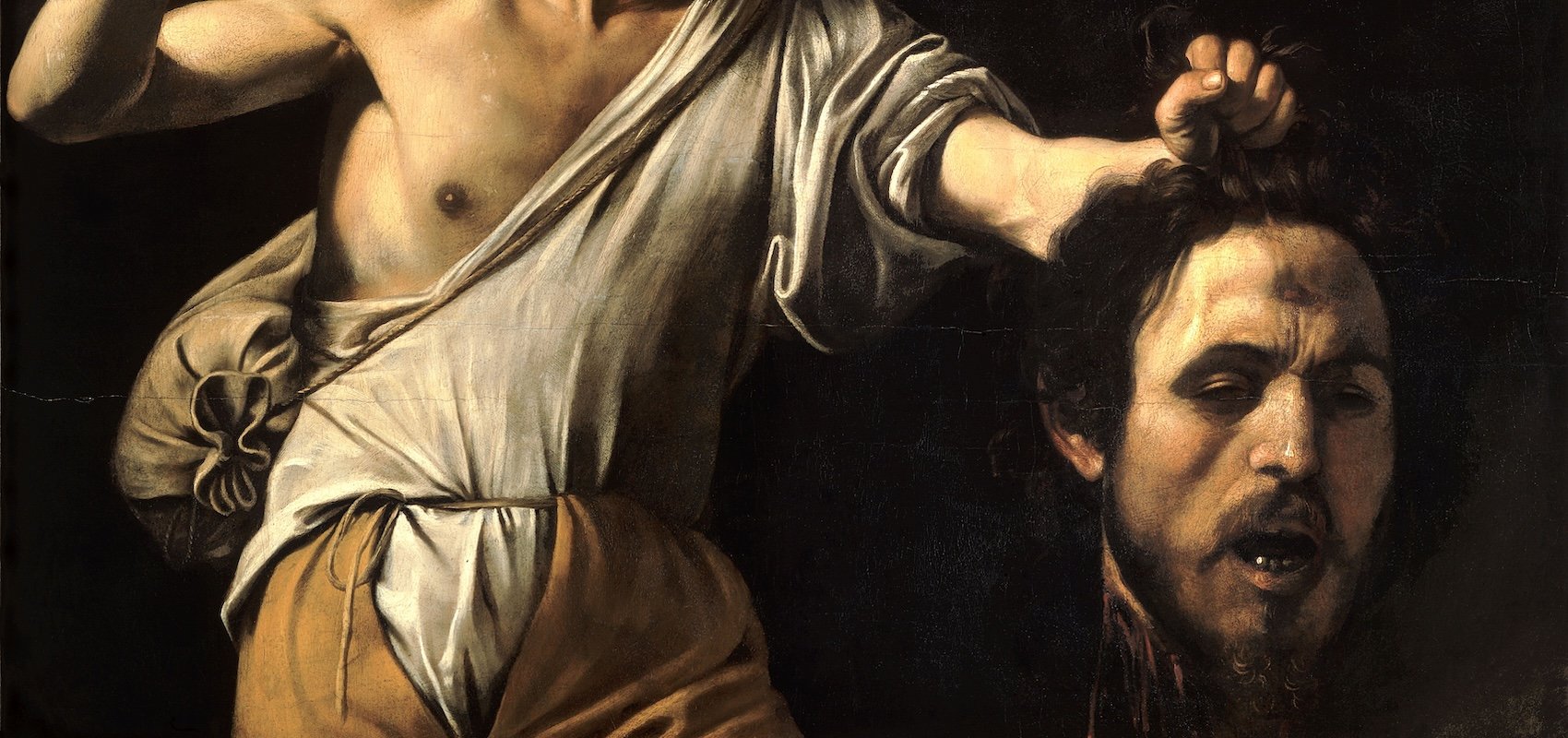
As part of his effort to be pardoned for Tomassoni’s murder, Caravaggio sent an unusual present to Cardinal Borghese: a picture of David with the head of Goliath. The giant’s severed head is a self-portrait, and the model for David is alleged to be one of Caravaggio’s assistants, Cecco del Caravaggio, who may also have been his lover. The picture bears evidence of haste; it may have been completed in hiding. On the sword are the enigmatic initials H-AS OS, which may be an abbreviation of the Latin phrase humilitas occidit superbiam. The precise date of this picture is controversial, as is its exact significance.
We might note here, as an aside, without drawing any conclusions, that Caravaggio had a fixation with cut-off heads even before he was sentenced to die in this manner. This fact might well explain his otherwise inexplicable fixation on John the Baptist, whom he painted up to nine times, once in mid-beheading, twice as a severed head on a platter. He painted only three versions of David with the head of Goliath.
On fleeing Rome, Caravaggio went first to Naples, where he was in demand as a painter. But he was impatient for a papal pardon and decided that the best way to get one was to present himself to the Grand Master of the Order of Malta and ask for a knighthood. Incredibly, he received one on July 14, 1608, two days and a year after his arrival on Malta, as a reward for completing a picture of the beheading of St. John the Baptist. This can still be seen in the co-cathedral of St. John in Valletta. A little after his induction, he was imprisoned for attacking a fellow knight with his sword. He was imprisoned on August 19 and escaped on October 6. From Malta he fled to Sicily. He completed some of his most impressive surviving paintings in Syracuse, Messina, and Palermo before deciding that he was not safe in Sicily, either. In the autumn of 1609, he arrived in Naples, where, toward the end of October, he was attacked outside a tavern by a gang of armed men who wounded him in the face.
Still Caravaggio dreamed of being pardoned. One of his last paintings depicts a bored, sullen John the Baptist and might have been sent as another gift to Cardinal Borghese. Caravaggio’s earlier depictions of John the Baptist often seem at least vaguely erotic; in one of them, the saint leers like a faun or satyr. The versions of John the Baptist in the Capitoline Museums and Doria Pamphilj gallery may have been depictions of Cecco del Caravaggio, the supposed young lover. There is also a Palazzo Barberini St. John the Baptist, which is a little more brooding. Here, in the Galleria Borghese painting, the saint is disillusioned. We are tempted to read this painting as an autobiographical expression of despair. One might almost conclude that Caravaggio, like John the Baptist, was getting impatient about his imminent beheading. But this might be an over-reading. In any case, Caravaggio did not die on a scaffold, or without his head. He expired of an illness, in mysterious circumstances, on July 18, 1610, while trying to get back to Rome.
After his death, everybody imitated him, often with dark, gloomy “Caravaggesque” paintings featuring shadows, vice, and at least the prospect of violence. But the fashion did not last very long. By 1630, Caravaggio’s approach was no longer in vogue—at least around Rome, where Raphaelite classicism was being revived. Order, beauty, classical ideals, and fresh air returned to Roman painting. Caravaggio’s reputation reached its nadir in the nineteenth century, when the great English art critic John Ruskin dismissed him as a mere ruffian, distinguished only by his preference for candlelight and villainy. Pace Ruskin, it is hard to find candles in Caravaggio’s work, but you get the point. Ruskin thought Caravaggio vulgar and depraved, and nothing more. We who admire Caravaggio ought to admit to ourselves that Ruskin was not entirely wrong in some of his detailed criticisms, even if we think he finally missed the point.
In 1951, the art historian Roberto Longhi organized a major exhibition of Caravaggio’s work in Milan. Since then, Caravaggio’s fame has come to surpass that of virtually every other Old Master. He is now spoken of in the same breath as Titian, Rubens, Rembrandt, and Velázquez, even though he lacks the range, skill, and sheer versatility of these apparent peers. His pictures are far more limited than any of theirs, and he never quite shows us anything like a positive ideal of beauty. Yet Rembrandt and Velázquez, at least, are unthinkable without the innovations they consciously adopted from Caravaggio. Was Ruskin’s judgment better than Rembrandt’s?
By contrast, painters who sought to restore a classical ideal, such as Mantegna, Botticelli, Raphael, and Nicolas Poussin, are less and less popular today. Art students tend to dismiss their work as pedantic or merely pretty. To modern eyes, their depictions of ideal beauty often appear ludicrous, even oppressive; their demonstrations of positive virtue seem boring, even repulsive. We moderns prefer artists like Caravaggio who neither teach nor preach, and who sometimes make us feel preemptively forgiven for our weaknesses and indulgences. When we are shown a picture like Raphael’s Transfiguration, our instinct is to shrink from the light. Caravaggio is more comforting. He assures us that it’s okay to have dirty feet. But can we justify our taste for Caravaggio if we think of ourselves as having moral standards, as at least trying to avoid vice and depravity?
Of course we can. Caravaggio smashed the tradition of the Cavaliere d’Arpino to bits. It deserved to be destroyed. That entire set of conventions was finished. As for the Renaissance itself, it had run its course long before. Caravaggio took his notions of realism as far as he could, until they began to show how limited and unsustainable they were. But were his ideas any more absurd than the ideas behind the classicizing project that gave us the glories of the High Renaissance? If Caravaggio destroyed the art of painting as the Cavaliere d’Arpino knew it, we should thank him, because in doing so he cleared the way for the renewal of classicism that was already beginning in the 1590s with Annibale Carracci, and would reach a new height with Poussin from the 1630s onwards.
We moderns are too saturated with sordid images and ideas to understand how to view a Raphael. He leaves us cold because we want to be shocked, indulged, and gratified, all at once. We are desensitized to his ideals of beauty. By contrast, in our fallen state, we are strongly attracted to Caravaggio, who seems as low-minded and appetite-driven as we are. He cannot see beauty directly, or show it to us except by the by. But he can teach us how to look for it.

YOU MIGHT ALSO LIKE
Timothée Chalamet Is Right About Art (ft. Suzy Weiss)
In this episode, co-founder and reporter for the Free Press, Suzy Weiss, joins Virginia and Germán to…
Helene Schjerfbeck’s Defiant Paintbrush
Helene Schjerfbeck (1862–1946) did not go gentle into that good night. In 1944, war still raging, the…
How Kanye Went Nazi
Last year, Kanye West—sometimes known as Ye—released a song titled “Nigga Heil Hitler.” The music video featured…
