

After the Spike:
Population, Progress, and the Case for People
by dean spears and michael geruso
simon and schuster, 320 pages, $29.99
Last year the United Nations Population Division predicted that global population will peak in approximately sixty years, at around 10.3 billion people. After that, the number of human beings will begin to fall. Population decline has already begun in sixty-three countries, including China and Russia. The cause is persistent low fertility. At the world scale, the number of children being born is already below the levels required for a stable population, generally considered to be 2.2 per woman in rich nations and a bit more in poor ones. More than half of all countries today have sub-replacement fertility rates. Japan, Canada, and most Western European countries have been below replacement for fifty years. Today, not only rich countries but even middle-income ones such as Mexico, the Philippines, and Iran are below the levels required to stave off future population decline.
And these are the optimistic forecasts. UN population predictions typically overshoot reality. A 2020 paper published in The Lancet forecast that global population would peak in the 2060s at around 9.7 billion, twenty years sooner and 600 million people fewer than the UN proposed. Population decline will only accelerate after this peak. By the end of the century, countries such as China, Japan, Thailand, and Spain are expected to be reduced to half their present size. The result will be some combination of rapid societal aging, the abandonment of rural areas and small towns, and perpetual mass migration, the implications of which are only now beginning to be contemplated.
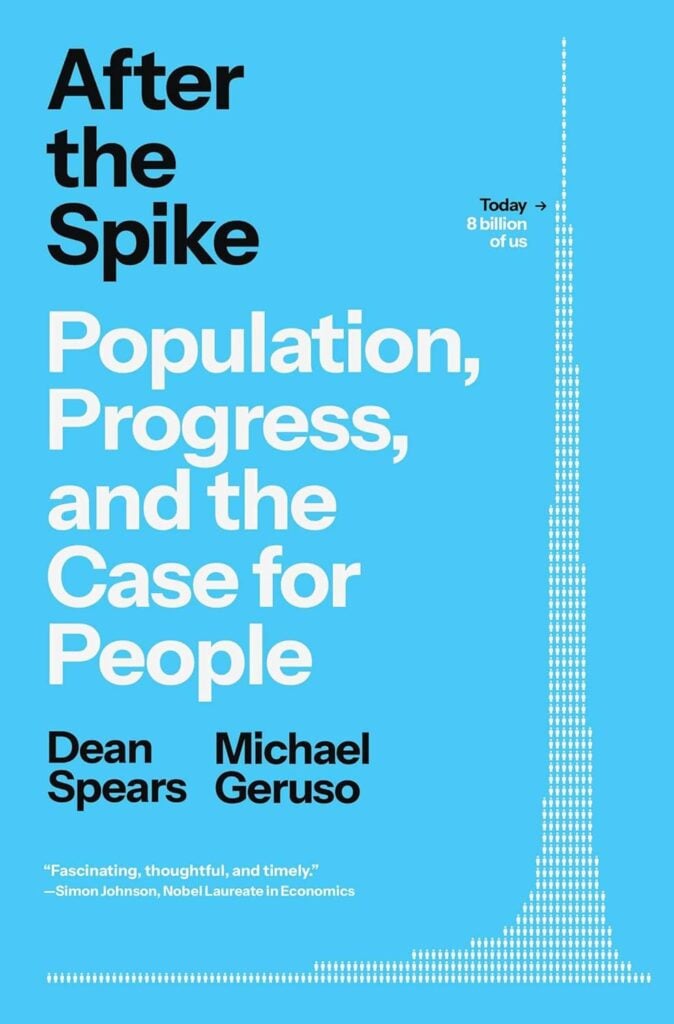
Conservatives have been writing about this topic for decades. Phillip Longman published The Empty Cradle in 2004, and Jonathan Last’s What to Expect When No One’s Expecting came out in 2013. Liberals, by contrast, have been wary of admitting that low fertility and population decline exist, much less that they are problems. They fear that simply discussing population will normalize racist and patriarchal ideas. Dean Spears and Michael Geruso, two economists at the University of Texas at Austin, aim to break the silence. In After the Spike, the authors advance what they call “the case for people” from a perspective rooted in economic, political, and philosophical liberalism.
In that After the Spike is of, by, and for liberals, this approach is a good thing. After all, it is liberals who need to be convinced that global depopulation rather than overpopulation is coming, that low fertility is a social problem, and that human existence is good. And if Spears and Geruso can convince liberals to support political, social, and cultural changes that encourage increased fertility, more power to them. Outside the liberal bubble, however, After the Spike falls well short of a convincing analysis of the population problem. Yet it fails in an interesting way that tells us a good deal about liberalism, why contemporary Western liberals have such a difficult time becoming pronatalist, and why liberal prescriptions for the problem are unlikely to succeed.
This is not to say that conservative pronatalism is guaranteed to work either. The headwinds of global low fertility are strong. As Spears and Geruso inadvertently show their readers, history gives little cause to believe a major fertility turnaround is possible, especially an engineered one. Though fertility policy can tweak the margins of human population, and every little bit helps, it will almost certainly fail to stabilize global population levels. Instead, the youngest readers of this book will live to see the first global decline in human population since the Black Death nearly seven centuries ago. The case for people should be made. At the same time, we must prepare for that case to fail.
After the Spike has two central goals. The first is to convince the reader that global population decline is coming. On this score, the book is a clear success. Spears and Geruso show that every country in the world today has either declining or sub-replacement fertility; even India and China, which together make up more than one-third of the world population, are, respectively, below and well below replacement. There are no “automatic stabilizers” guaranteed to keep fertility rates up and the global population stable. What produced the “population bomb” of the twentieth century is wholly incapable of producing similar growth in the twenty-first.
The book’s second goal is to convince the reader that global population decline is bad. Here simple demography will not suffice. To make the “case for people,” Spears and Geruso must choose economic, political, and philosophical arguments that they believe in and expect will resonate with the reader. Their arguments are rooted in core liberal values: equality, choice, progress, humanity. If the reader doesn’t agree to privilege these values, or finds the authors’ unwavering commitment to them impractical or naive, he will quickly tire of this book. After the Spike makes a lengthy and serious effort, however, to sway the liberal reader. Fully half its pages are devoted to convincing liberals that there is no contradiction between reversing fertility decline and contemporary liberal commitments.
The authors argue, for instance, that depopulation will do nothing to help the climate. On development, they show that the quality of life in poor countries has improved despite tremendous population growth. They also argue persuasively that past technological, economic, and social progress has been dependent on population growth. As “progress comes from people,” a future of population decline will be a future without progress.
Here Spears and Geruso run into a contradiction that troubles their entire book. They admit that progress has been driving down fertility rates “for several hundred years”—for at least as long as we have reliable records—because “a better world, with better options, makes parenting worse by comparison.” Children increasingly compete against careers and consumption and leisure and self-actualization for space in adults’ definition of the good life. This is economists’ now-standard “opportunity cost” explanation of low and declining fertility. As much in India as in the U.S., today there are just too many ways to spend time and money other than on children. Because Spears and Geruso are so dedicated to the value of free choice, they shrink from any suggestion of changing people’s preferences. So they present no case for nudging behavior by increasing the benefits of having children or the costs of not having them. The only thing to do, in their view, is to keep reducing the “burden” of having children among people who currently want them, in a constant race against (and yet for) progress.
One is led to wonder how low both actual and opportunity costs can go. Can they go so low that “enough” children will be born to stabilize global population? The authors have nothing to say on this point, because they don’t take the social contradictions between fertility and progress seriously. The book faces this problem especially in its discussion of fertility and feminism. Spears and Geruso insist that gender egalitarianism is perfectly compatible with replacement-level fertility. In fact, they venture that gender “fairness might be the only way to stabilize the population.” Yet their evidence is spare and unconvincing. The authors offer the United States between 1975 and 2010 as a “proof of concept.” During this period both gender equality and the fertility rate rose together. Rising female employment, a falling gender wage gap, more female education, more female professionals and leaders, more legal equality, and more babies! Yet Spears and Geruso conveniently ignore the preceding and following periods. Rising gender egalitarianism in the 1960s and early 1970s coincided with the steepest fertility fall in U.S. history. Progress in gender egalitarianism since 2010, whether in wages or educational attainment or seats on the Supreme Court, is likewise concurrent with falling fertility.
The authors also ignore the key question of population stabilization and how to reach it. Over the thirty-five years in question, only two (2006 and 2007) saw above-replacement fertility rates—and that was due less to feminism than to unusually high fertility among young Hispanic women, particularly recent immigrants. “Fairness” also has a poor fertility track record internationally. The four large Nordic countries, the most gender-egalitarian in the world, now have total fertility rates in the “very low” range, below 1.5. Excepting two years in the early 1990s in Sweden, they have not been above replacement rate in more than fifty years.
Though progress and gender egalitarianism are values Spears and Geruso are keen to defend, the authors’ most basic commitment is to individual choice. Not only is it their supreme value; in their view, it is also the fundamental cause of human fertility. The authors demonstrate, with good evidence, that “population control has never controlled the population,” at least not significantly over the long run. Neither communist China’s attempts to drive fertility rates down nor communist Romania’s attempts to drive them up accomplished anything more than short-term effects, at the cost of tremendous human suffering. Thanks to universal “socioeconomic development,” from urbanization to modernity to the waning of patriarchy, no power can change population at mass scale against the combined choices of billions of individual women. The authors are so careful not to tread upon free choice that they repeatedly affirm the freedom not to have children as much as the freedom to have them. Thus, all we can—and, in their view, should—do is “make it easier to choose children.”
Who will do this work of easing? According to Spears and Geruso, “humanity” will. Throughout After the Spike there are only two actors: the individual, who chooses; and humanity, which is tasked with enabling individual choice. Not even states—much less families, schools, clubs, religious organizations, neighborhoods, voluntary organizations, the media, or political parties—are tapped for a meaningful role. There is only “humanity,” the great “we” who hold “shared responsibility” for the future, because “responding to global depopulation is going to have to be something that people do together.”
This is a deeply unsatisfying answer. Humanity is not an actor. There is no global polity with an ability to aggregate and express the collective will of the entire human population. Of course, it may be that the appeal to “humanity” is not meant to be persuasive. It allows the authors to cultivate an aura of doing something, without engaging in a discussion of politics. They thus avoid questions of the exercise of power through strong cultural norms, taxation, regulation, or law—all of which would entail a violation of free choice. At the end of the book the authors cannot even muster a call for a personal commitment to reversing population decline by getting married, starting a family, or adding one more child. Instead the reader is offered vaguely social-policy-oriented slogans to “aspire bigger,” “join the conversation,” and “get started.”
But can the bearing and raising of children be made cheaper than all the possible low-fertility adult lifestyles that, thanks to progress, are now on offer? What if driving down the opportunity cost of having children simply isn’t enough? After all, Spears and Geruso have given us good reason to believe it isn’t. Fertility rates have been declining for centuries, and there is no invisible hand guiding human populations to a stable equilibrium. Being liberals, the authors simply assume that nature and tradition will drive the reproduction of society. But as the sociologist Anthony Giddens has argued, contemporary Western societies live after nature and after tradition. We no longer accept either necessity or fate. We refuse to believe we are the subjects of any power beyond the reach of individual or collective human choice. From a liberal perspective, of course, this is progress, born of our technologies, from airplanes to genetic engineering to birth control. As such technologies spread across the globe, all people come to live with the same autonomy from nature and tradition. And with nothing compelling us to choose children, the evidence strongly indicates that we won’t. At least, we won’t choose enough of them to stop the global population from running down the steep slope of the spike as rapidly as we ran up it.
The way in which humanity addresses low fertility and population decline will be much the same as the way we have already addressed climate change. The great projects to stop atmospheric CO2 concentrations at 350 parts per million or limit temperature increases to +1.5°C from pre-industrial levels have already failed. Instead, individual governments and industries have pursued their own divergent interests while working at the margins to develop “green” alternatives—even as global fossil fuel consumption, thanks to technological progress, continues to increase. As low birth rates persist, some governments will lean heavily on immigration, while others will choose capital investments to compensate for labor shortages. Many policies for radically lowering the cost of bearing and raising children will be tried. Some will succeed on the margins, but most will not. Societies will adapt to their own distinctive combinations of rapid aging, mass immigration, urban population concentration, and peripheral area depopulation.
This process won’t continue forever. Our future is not extinction. Low fertility and population decline contain the seeds of their own destruction. Spears and Geruso show that “progress comes from people.” A future of fewer people will therefore produce a future of less progress. If population decline is steep enough, progress will halt, thus eliminating the force that undermines human fertility. Five billion humans—half the number at the top of the spike—won’t build lunar bases, use room-temperature superconductivity, reverse aging, or merge with AI. We might even lose many technologies, institutions, and cultural practices that are dependent on complex global systems. Then nature and tradition will return, and with them the individual motivation and social organization necessary for human reproduction.
No one can say when it will occur. All we can know is that that world will be quite different from our own. It will likely be a world that sees its own future not in the advancement of individual autonomy, but in the fruitfulness of its people.
Image by theodoritsis, licensed via Creative Commons. Image cropped.

YOU MIGHT ALSO LIKE
Trump’s Civilizational Project
Secretary of State Marco Rubio spoke at the recent Munich Security Conference. Last year, Vice President JD…
The Real JD Vance (ft. Frank DeVito)
In the latest installment of the ongoing interview series with contributing editor Mark Bauerlein, Frank DeVito joins…
How Kanye Went Nazi
Last year, Kanye West—sometimes known as Ye—released a song titled “Nigga Heil Hitler.” The music video featured…
