
No doubt many people will offer their own reflections on the life of Archbishop Fulton Sheen now that the Vatican has approved his beatification. I offer these reflections on some lesser-known aspects of the life of this man of exceptional faith and character.
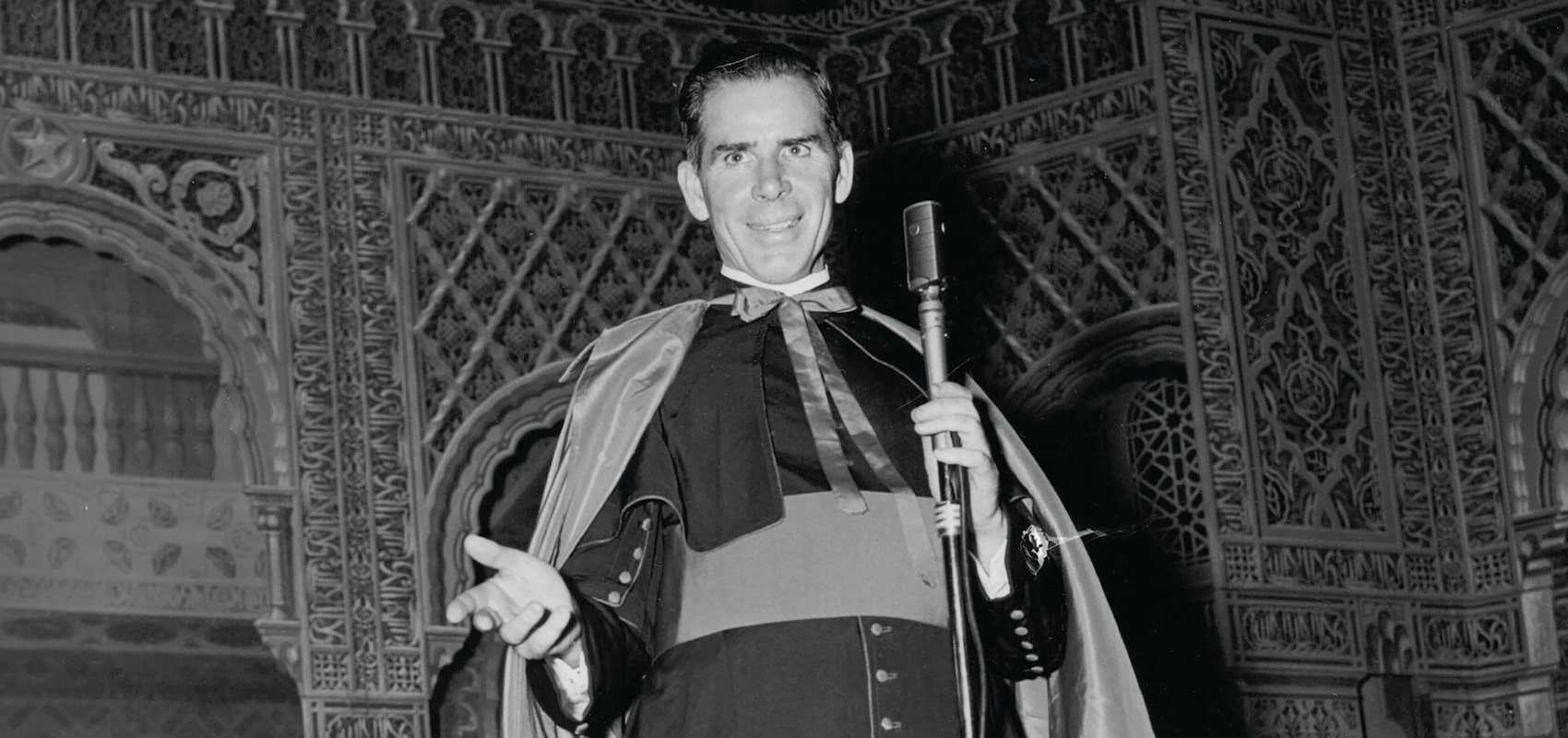
Fulton Sheen was a televangelist, a charismatic bishop, a media personality with piercing eyes, a scholar, a celebrity, and the host of an award-winning television program. Yet these are not reasons for the Church to beatify or canonize anyone. Many people possess similar qualities but are not thereby distinguished for their personal holiness.
The reason to honor a blessed or a saint is because of his or her life of heroic virtue. In my opinion, Sheen’s greatest quality is his humility. It may seem odd to emphasize the humility of a man whose Emmy-winning program, Life Is Worth Living, captured a television audience of thirty million viewers, outperforming Milton Berle in his time slot. However, Sheen used his talent to draw attention to Christ more than himself. As he quipped, all the credit was due to his writers: Matthew, Mark, Luke, and John. Famously known for his humor, Sheen included a chapter in his autobiography, Treasure in Clay, dedicated entirely to the value of jokes.
Sheen’s humor was self-deprecating, which was an indispensable element of his success in his connection to his viewers. Because he could laugh at himself, he quickly won over his audience, not just Catholics, but also Protestants and Jews—many of whom regarded Life Is Worth Living as must-see television each week. He brought his audience with him not through complex theology, but through his discussion of ordinary ideas of science, psychology, history, or literature, which became a springboard for him to talk about eternal, spiritual truths.
Sheen did not look down on people nor talk over their heads. He was equally at home speaking with the taxi driver, the stewardess, or the neighbor on the street as he was among the powerful and elite. He brought about many converts to the faith, but when asked about the number, he responded humbly by stating that he doesn’t count them, lest he be tempted to take credit for them instead of giving it to God. Sheen used his considerable talent not to promote himself, but to witness to Jesus Christ. People were captivated by him because his genuineness was naturally evident.
From the time Sheen was ordained a priest in Peoria, Illinois, in 1919, he dedicated himself to a daily holy hour before the Blessed Sacrament. Throughout sixty years of priesthood, he devoted more than 21,000 hours of devoted prayer to Jesus Christ. Sheen did not merely learn about Jesus in the classroom or from the tomes in libraries; he knew him personally from his deep prayer life. This insight gave him a brilliance that transcended academia. His faith in Jesus was personal and his knowledge of Jesus’s love for him was demonstrated most by the cross.
Suffering is a fact of human life, but saints (and the blessed) are distinguished by the way they respond to the cross. Sheen described himself as having a fear of the cross, which he consciously worked to overcome throughout his life. Sheen’s self-denial manifested early in his life. He was a student at St. Viator College in Bourbonnais, Illinois, when he received a dream-come-true, all-expenses-paid scholarship to pursue any academic degree he wanted. It was a real sacrifice for him to give this up to enter St. Paul Seminary in Minnesota. The irony was that his priesthood eventually took him to centers of learning (in Washington, D.C., Louvain, and Rome) that surpassed even his wildest dreams as a young college student.
Sheen found the cross in his commitment to the truth. As a key player in the Second Vatican Council, he sought to implement its teachings, bringing the Church into dialogue with the modern world. In an era marked by pitched battles between conservative and liberal camps, Sheen spoke of the necessity of both individual and social justice, neither of which could exist without the other. In the Diocese of Rochester, he was too liberal for the conservatives who feared modernization, but he was too conservative for the liberals who wanted to transform the Church wholesale. He attempted to provide for the poor in need of housing, yet he was also careful in his discernment of priestly candidates, firm on moral teachings, and unquestioningly opposed to communism. While navigating partisan disputes, there is no doubt that Sheen suffered. He didn’t point one-dimensionally to the right or to the left; he pointed up. He transcended traditional politics by elevating us toward the divine and keeping our eyes fixed on God, the source of all our hope.
Much more could be said about this man of God, and certainly more will be written about his contribution to the Church in the years and decades ahead. In 1979, Pope St. John Paul II summed up this powerful evangelist: “You have written and spoken well of the Lord Jesus Christ. You are a loyal son of the Church.” May Sheen’s legacy shine in the continued conversions of those who, through him, personally meet Jesus Christ.
