
On a late September morning, I approached the registration table outside the entrance to a small Greek Orthodox church on Manhattan’s Upper West Side. I pulled up a QR code on my phone to be granted access to meet the Ecumenical Patriarch of Constantinople. I was then directed into a holding area. Once there, a parish council member told us that the people working the welcome table had been wrong, and that we were supposed to wait downstairs. I found out five minutes later that the parish council member was also mistaken. I was hardly shocked by the level of disorganization: “I don’t belong to an organized religion—I’m Orthodox,” as the joke goes. Orderliness and regimentation are Rome’s fortes, not Constantinople’s—and certainly not Greece’s.
I was further disappointed by the lack of reverence of the attendees, some of whom were texting, doomscrolling, and even talking loudly in the middle of the patriarch’s homily. Yet I can’t say this shocked me, either. Despite the embedded cultural piety of the Orthodox, we aren’t quite the most reverent of people. Thus, it wasn’t difficult to pick out the converts in the crowd. On top of their decidedly non-Greek phenotypes, their ostentatious demonstrations of piety—dramatically crossing themselves, bowing in front of icons repeatedly, holding prayer ropes, and wearing headscarves—were dead giveaways.
As someone who left Eastern Orthodoxy behind, I find the recent uptick in converts both fascinating and perplexing. I, like many of them, struggle with the predominance of the cultural element in Orthodoxy—it was one of the reasons I left it for Roman Catholicism. Too many cradle Orthodox reduce their faith to a mere cultural phenomenon, equating Christian life to decorating their houses with icons and eating lamb on Easter while downplaying the call to take up one’s cross and follow Christ. And yet, I fear that too many “Orthobros” have swung the pendulum too far in the other direction, dismissing the cultural part as a mere appendage to, or even a distraction from, the essence of Orthodoxy. Rather than casting it aside, recent converts need to learn to contend with the complicated relationship between Orthodox Christianity and culture.
As a baby, I was baptized in both the Catholic and Orthodox Churches—which is canonically illicit in the eyes of both Churches (not that my nominally religious parents cared). I ended up going to the Orthodox Divine Liturgy much more frequently than to Catholic Mass. This was, in part, because my mother’s Greek family members were pushier than my father’s Italian family members. It was also because I preferred the vibrant experience at my mom’s Greek church to my dad’s deracinated Catholic church, where nondescript “white” suburbanites sang drab 1970s hymns and the priest preached about how Jesus wants us to be nice to others. The only thing I liked about Catholicism was when my dad took me to his childhood parish once a year for the intensely Italian feast of St. Gerard.
Yet as much as I loved the cultural richness of our Orthodox parish, I desired more than just culture: I wanted to know and follow God himself. Whenever I asked the priest about how I could know Jesus personally, he said to just keep praying and going to the Divine Liturgy. The more I asked questions, the more he seemed to get annoyed. Even an Orthodox Studies professor at my university dismissed my questions, telling me that the Orthodox Church is the original church—and that, besides, I was Greek: “You can’t convert from being Greek!” The only people who took my questions about faith seriously were Catholics. It was through these encounters that I decided to enter (or re-enter, depending on whom you ask) into full communion with Rome. When I told my Greek grandfather, he berated me for “turning [my] back on our culture.”
Having been exposed to the richness of the Divine Liturgy from such a young age, I found it difficult to attend regular Novus Ordo Masses. And while I was allured by the Tridentine Latin Mass, I was repelled by the ideological charge at the parishes that celebrated it. It wasn’t until I got involved in an ecclesial lay movement focused on forming joy-filled missionary disciples that I started to see my faith flourish. Yet liturgically, I remained stuck. As much as the ethnic aspect of Orthodoxy repelled me, having to choose between drably assimilated parishes and polemical trad ones made me miss it. My nostalgia led me to seek out ethnic Catholic parishes where cultural traditions were intertwined with the liturgy.
Surely, cultural traditions have played a major role in Catholic practice throughout history—especially in comparison to most branches of Protestantism, which tend to draw up a dichotomy between the “purity” of faith and merely “human” inventions. Yet, it’s easier to extricate the ethnic element from Catholicism than from Orthodoxy. This is in part because Orthodoxy’s ecclesiastical model is explicitly arranged around national ties. Catholics may have a history of multiple “national parishes” within the same locale, but said parishes were all under the canonical jurisdiction of one diocese. In Orthodoxy, multiple dioceses can have jurisdiction over the same locale: one bishop for the Greeks, one for the Russians, one for the Antiochians.
The ethnic ties are not just structural, they’re spiritual. For the Christian East, God having become flesh is truly a mystery, one that interpenetrates human experience in ways that transcend human logic. Lacking the legalistic and rationalistic theological foundations of the Christian West, it’s more difficult for the deeply mystical Orthodox to clearly delineate between the “religious” and the “human.” This is both Orthodoxy’s strength and weakness.
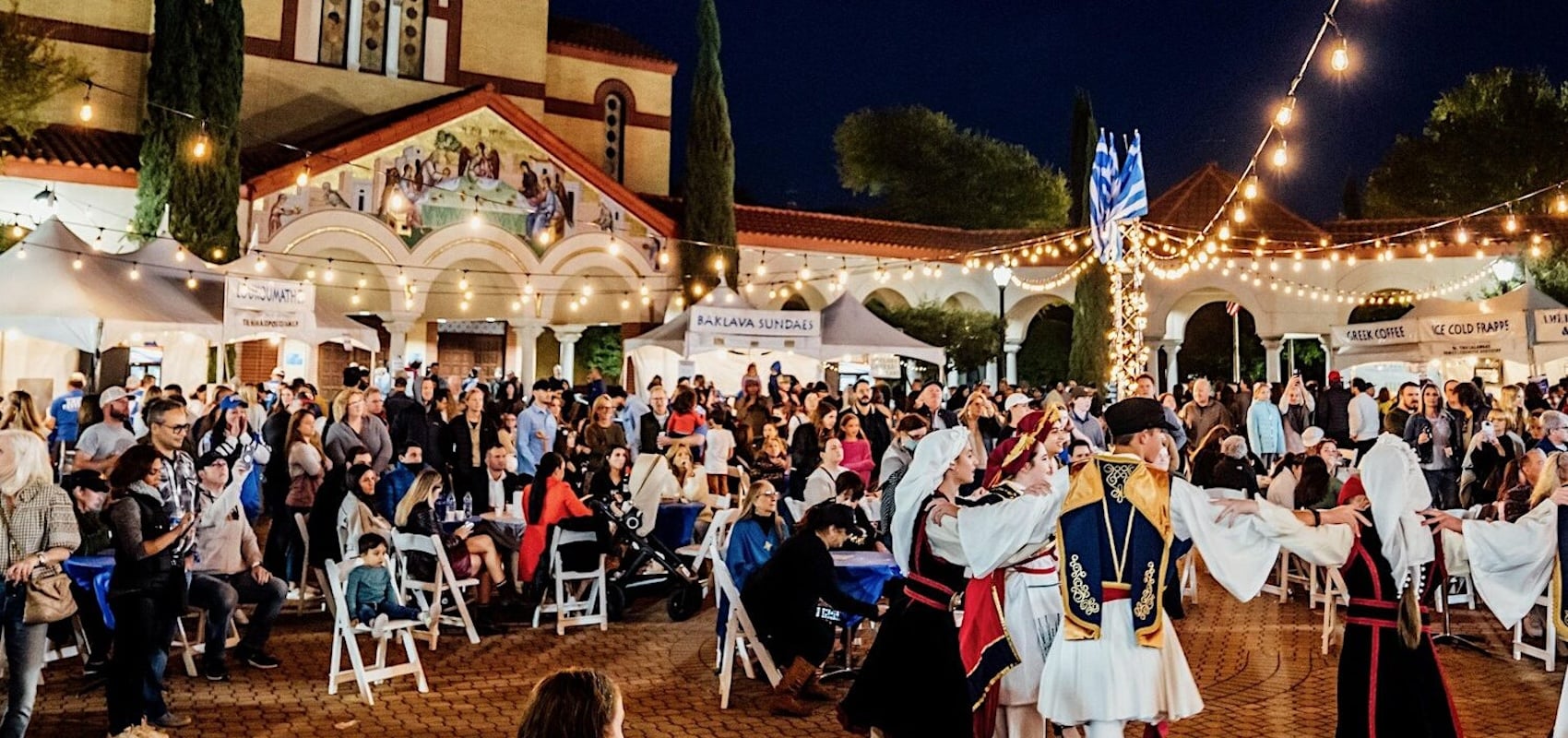
Sadly, too many cradle Orthodox reduce their faith to its cultural expressions, ignoring the demands that it makes on their hearts, minds, and actions. I’ve known many Greeks who are outwardly pious, but who behave as if they never encountered Jesus. Yet the converts who go the opposite extreme naively ignore the spiritual insights that the cradle Orthodox—even the most irreverent ones—have to offer. A lifetime of going through the motions—even without understanding or fully believing in them—imparts faith to a Greek child as if by osmosis. While gestures like cracking red eggs on Easter, walking under the kouvouklion on Good Friday (even if you arrive an hour late), and setting up an icon corner in your house do not amount to a mature, fully conscious embrace of the gospel in themselves, God surely makes himself present through them. He’s even present at the Greek festival, even if you only go for the loukoumades, dancing, and to catch up on church gossip.
Furthermore, cradle Orthodox are a reminder that faith is not the product of one’s moral effort or intellectual striving, nor is it a countercultural identity among others that one can simply choose to adopt. Rather, faith is a gift given by God and transmitted through a particular body of believers—with the emphasis on God’s initiative, not ours.
This is not to say that converts will never fully understand Orthodoxy. As Fr. Andrew Stephen Damick writes, Orthodoxy “is for everyone and doesn’t require a particular cultural identification.” But the Anglo from the Midwest who converts to Orthodoxy from Methodism or nondenominational evangelicalism is likely to have a harder time entering into the mysteries of her newfound religion than someone who breathed the ethereal air of Orthodoxy from a young age. Even my poorly catechized, nominally Orthodox family members grasp certain things about the faith better than the converts who have watched countless reels about early Church history and who can quote lines from the Philokalia and Elder Paisios’s writings from memory. As much as it would be unfair to write off all converts as mere LARPers, those who are content with tossing out Orthodoxy’s cultural dimension wholesale could be accused of never fully understanding it.
Furthermore, converts underestimate the extent to which assimilation and cultural deracination are a slippery slope to secularism. Contrary to the dictates of the Enlightenment philosophes, “religiosity” cannot exist in a vacuum. It cannot be slapped onto one’s life from the top down. One can choose to be deeply religious, but if one’s faith doesn’t sink its roots into all aspects of life—expanding beyond being a mere “lifestyle choice”—it is bound to atrophy into yet another self-referential identity category, one not all that dissimilar to those of Social Justice Warriors and “gender transitioners.”
Converts can, of course, opt to bypass the cultural in-grouping and lack of devotion at ethnic parishes by opting to attend an Orthodox Church of America parish. I’m not quite sure, however, that this can solve the seemingly perpetual tension between faith and culture found in Orthodoxy. Converts who shy away from ethnic parishes will miss out on the value of Orthodoxy’s cultural dimension. And more importantly, they will deprive cradle Orthodox from the opportunity to encounter zealous youngsters who might possibly reignite the dormant spark of faith that was imparted to them by their cultural upbringing. By learning to inhabit the same spaces together, cradle Orthodox and converts can help make the complex tension between faith and culture that is part and parcel of Orthodox Christianity a fruitful one.

YOU MIGHT ALSO LIKE
Turned Away on Palm Sunday
In politics, diplomacy, war, or pretty much any field of human interaction, one must contend not only…
Timothée Chalamet Is Right About Art (ft. Suzy Weiss)
In this episode, co-founder and reporter for the Free Press, Suzy Weiss, joins Virginia and Germán to…
A Medieval Pilgrimage in Modern Assisi
When you go to the hilltop town of Assisi, you’re immediately struck by how medieval it is:…
