
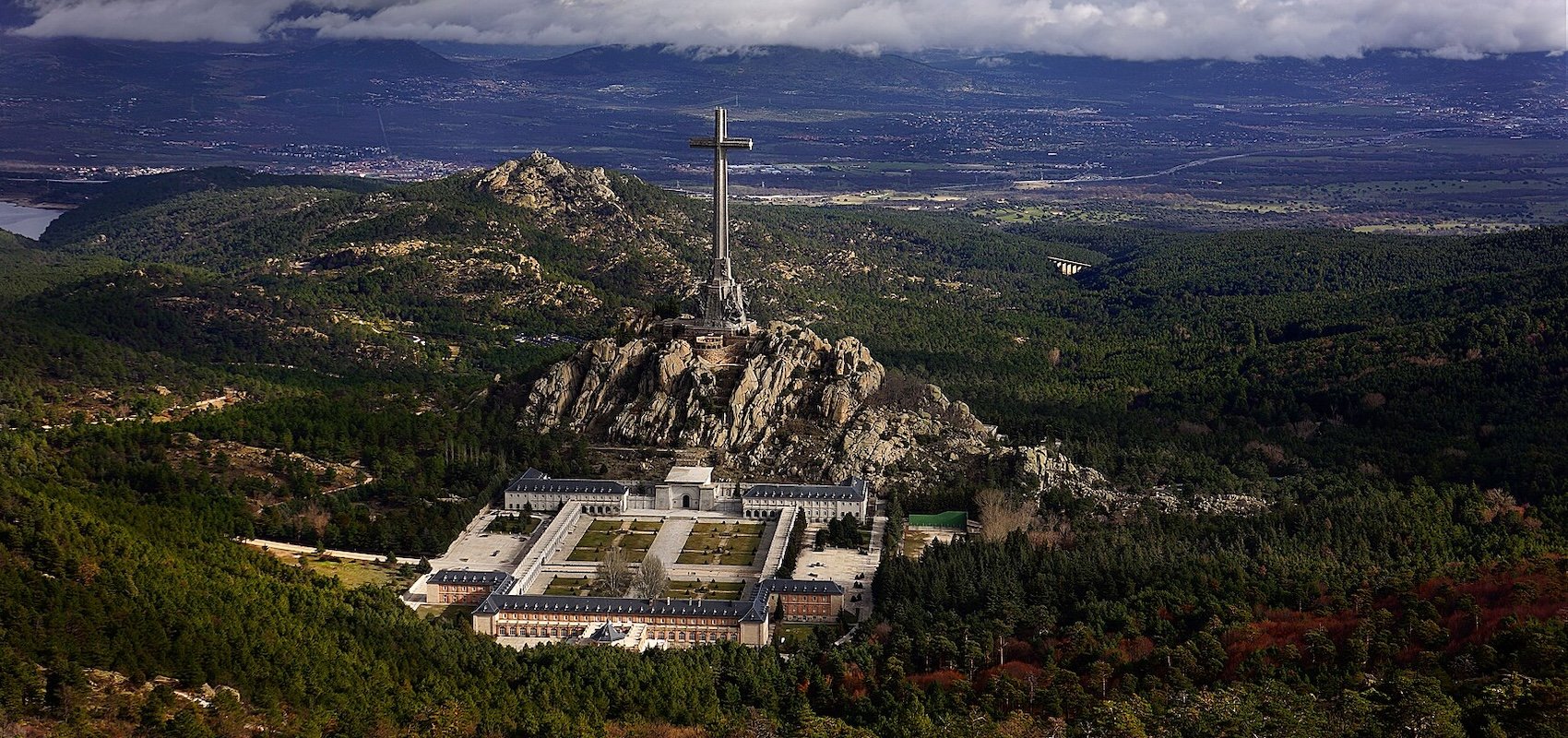
In recent months, Spain has become an epicenter in the battle over Europe’s diminishing Christian identity. At stake is the fate of the Valle de los Caídos—the Valley of the Fallen—where the world’s largest cross towers above a monumental basilica carved inside a mountain. Originally commissioned by Gen. Francisco Franco as a place of reconciliation after Spain’s civil war, the leftist government is stripping the valle of its Catholic meaning.
Earlier this summer, Spanish Prime Minister Pedro Sánchez advanced the “resignification” plans by convening a jury to review international proposals, some of which recommend altering the basilica and even the monumental cross itself, despite earlier assurances that the cross would remain untouched. On November 11, the winning proposal was announced, which will materially diminish the religious identity, architectural integrity, and historical purpose of the valley. According to the government’s own statements, the project intends to create a “great crack,” a horizontal rupture across the valley’s esplanade, intended to transform the site into a “space of dialogue and plurality.” It will also eliminate the staircase leading to the basilica and replace it with a large lobby with an “interpretation center” whose purpose is to reframe the valley’s meaning according to state-defined ideological criteria.
As Americans, we should be unsettled that one of the most iconic Christian monuments in the world is threatened with destruction by the government of a European ally—one that was once a bastion of Catholic humanism. The site built to reconcile Spain after its brutal civil war is at risk of being entirely transformed from a place of prayer and remembrance to a state-controlled museum advancing an ideological agenda that erases all traces of Francoism.
The Spanish left’s wars on Franco’s legacy and the Christian faith are nothing new. In 2019, Franco’s remains were exhumed and transferred from the valle itself. Earlier this year, the government is also thought by many to have forced the resignation of the valle’s previous Benedictine prior, Br. Santiago Cantera. The area around the valle (about an hour’s drive from Madrid) used to have shops and restaurants, and the Benedictines used to invite pilgrims to tour the foot of the cross and walk the surrounding Via Crucis (Stations of the Cross), but all of these have been closed in recent years.
In this moment, leaders from across the West must stand and fight. What does it say about Christians if we allow the largest cross in the world, the most important symbol of our faith, to fall without putting up a fight? The causes of religious liberty and the championing of our cultural heritage are for all Christians in the West, not just in Spain or even in Europe. Catholic leaders, especially, have a duty to stand up for the persecuted members of our universal Church. The Church in Europe faces a different kind of persecution than that of Nigeria, for instance, but freedom of conscience, speech, and worship are nonetheless eroding. And yet, save for a few exceptions, our leaders overwhelmingly choose compromise and appeasement. This is not only wrong but entirely alien to the instincts of Europe’s Christian past, which raised up a continent of warriors through centuries of invasions by the Ottoman Turks.
The persecution in Spain is America’s fight too. The Christian tradition is the foundation of our civilizational bond and has allowed our respective free societies to flourish. As Americans, we inherited a particular tradition of Spanish Catholic humanism, and the Valley of the Fallen is one of its greatest living testaments. From the magnanimity of the Surrender of Breda to the witness of Bartolomé de las Casas, the Spanish embodied a Christian spirit of victory tempered by mercy, restraint, and humanity toward their conquered. Though imperfect (as all nations are), the Spanish were among the first to encourage the sacrifice of Christian missionary work, and to evangelize the people that came to be Americans.
At the Munich Security Conference last February, Vice President JD Vance declared, “What I worry about is the threat from within, the retreat of Europe from some of its most fundamental values—values shared with the United States of America.” These are the values we inherited from Christian Europe, and that for the past 250 years have defined our identity. It is essential that we raise them in matters of foreign policy.
It is now in the U.S., rather than Europe, where the Christian faith is most freely championed. The Spanish government dares to persecute the Catholic Church in Spain because it’s politically safe for them to do so. Younger generations enjoy Western freedoms and culture but have little interest in religion; and too many members of the Church are content to see their faith relegated to the private sphere and are indifferent to the attacks on the Christian identity of their nations.
Younger believers, who will someday be the only ones left to steward the faith, are growing up in a world where the message of Christian love is being extirpated. My generation seems uniquely unaware of how Christianity not only built our free societies but is the very key to overcoming the profound evils of political violence and terrorism. We’re living in a world increasingly shorn of the message of the cross, the sign par excellence of reconciliation, and the source of the Western world’s goodness. The Valley of the Fallen is a great symbol of Spain, but the largest cross in the world testifies to the towering significance of Christendom.
In 1084, St. Bruno of Cologne formed the Carthusian order under the motto stat crux dum volvitur orbis—“the cross stands while the world turns.” This is beautiful and true. The victory of redemption will always triumph over earthly matters. And yet there has never been a cross that just stood. The Cross of Christ is no static burden. It falls to modern-day Simons of Cyrene to carry it.

YOU MIGHT ALSO LIKE
Turned Away on Palm Sunday
In politics, diplomacy, war, or pretty much any field of human interaction, one must contend not only…
Timothée Chalamet Is Right About Art (ft. Suzy Weiss)
In this episode, co-founder and reporter for the Free Press, Suzy Weiss, joins Virginia and Germán to…
A Medieval Pilgrimage in Modern Assisi
When you go to the hilltop town of Assisi, you’re immediately struck by how medieval it is:…
