
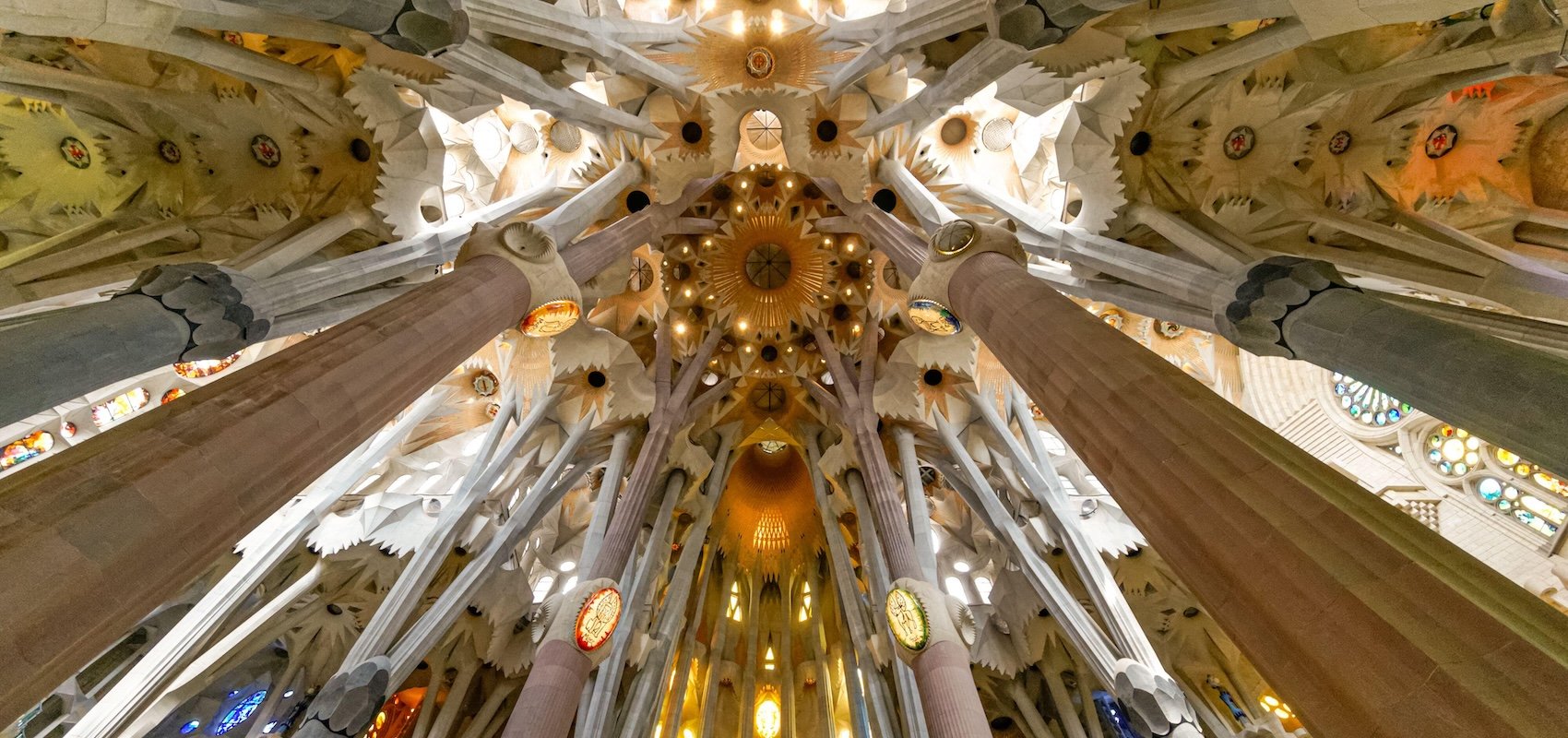
This year marks the hundredth anniversary of the death of Antoni Gaudí, the great medievalist-modernist architect from Catalonia. Barcelona is celebrating in a variety of ways, from a commemorative Mass on June 10 to a light and music show at Casa Batlló. Most importantly, the builders of the Sagrada Familia have rushed to install the final part of the cross, which stands on top of the tallest of the basilica’s eighteen towers: the Jesus Tower. The cross, covered in white ceramic, will be illuminated at night so that it will serve as a beacon for the city around the clock. 2026 is, in other words, a good year to visit the Sagrada Familia, or revisit it to see it with fresh eyes. And that is exactly what I’ve just done.
After I left the Sagrada Familia, my dad called me to ask what it felt like to be there. I think I muttered something uninteresting, but what I should have said was: This place feels palpably holy. Saturated with joy. It is made up of a riotous circus of daring shapes and brilliant colors that surprise you, everywhere you look, because everything is so unexpectedly playful and exuberant. On the outside of the church, for instance, the soaring pinnacles culminate in a star (for Mary), or in crosses (for the martyr apostles), or in the ox, lion, eagle, and man for the evangelists. Animals are carved into the stone almost everywhere, and not only the obvious Christian ones, but also dogs and horses and worms and butterflies and snails, and even the lowly armadillo. Elsewhere, turtles serve as the foundations of columns. If you can put down your phone for a few minutes and only look, you’ll burst out laughing at all of the unexpected, playful, and whimsical details you find.
Just as there are snatches of Latin throughout the poetry of Dante, so, too, are there phrases from the liturgy and the Bible woven into the fabric of the design: Alleluia! and Sanctus Sanctus Sanctus and names for Jesus—Power, Salvation—are carved and painted on the towers. On the inside, names of holy places touched by the finger of God—Jerusalem, Rome, Bethlehem, Guadalupe, Fatima, Lourdes—stand at the center of the rose windows.
For a medievalist like myself, I’m delighted by how close Gaudí’s work is to a medieval cathedral: Like a medieval cathedral, Gaudí’s “temple” (as he called it) is an icon of the universe, including everything from worms to stars, from flowers to angels. A passage from Hugh of St. Victor comes to mind:
See how the [world’s] multitude clearly figures forth [the] power [of God]: look at the stars of the heaven, the sands of the sea, the dust of the earth, the drops of water, the feathers of birds, the scales of fish, the hairs of animals, the grass of the fields, and the fruit and leaves of the trees. The individual creatures are not only innumerable, but the kinds of creatures are also innumerable!
But at the same time, Gaudí goes about doing these medieval things in very unmedieval ways. To begin with, the Sagrada Familia draws not just on different things but on different art styles: Gaudí’s Nativity Facade, on the eastern side of the church, is luscious, botanical, and full of art nouveau vegetative motifs. But the Passion Facade, on the western side, is stark, desolate, and bare, full of faceless, unemotional, masked soldiers in the cubist style—the style of the dying West.
For a medieval architect, “art imitates nature” would have meant that art can reveal those deep structures that nature can only “write out” with a “shaky hand,” as Dante puts it, because nature copies out the Platonic forms imperfectly. But by the time of Gaudí, understanding of what those “deep structures” and “deep forces” of nature looked like had, obviously, undergone a radical transformation: Geology taught that the faces of our landscapes were formed by endogenic and exogenic forces, not the geometrical shapes of Plato, and the biological forces were made up of waves of bursts of life.
So although Gaudí’s zoological figures tend to be symbolically geometrical, his decorative patterns take on the patterns of nature and biology. The ceiling, which looks like a gigantic honeycomb, is supported by columns that branch, like the limbs of trees, into the irregular pattern of a forest canopy. The Nativity Facade, appropriately, looks like a cave. And yet, despite the bewildering variety of flavors and textures and shapes within this basilica, it seems particularly focused on meditating on two names that Christ gave to himself: Light and Life.
We entered in the late afternoon, and so the setting sun was already illuminating the glass. Gaudí’s glass is simple, but the light is projected onto the cool, neutral walls, making them kaleidoscopically colorful. And if Christ is the inner light of the world, he is also its inner life: The great doors on the Nativity side of the basilica are covered in a dense foliage of leaves.
Sagrada Familia, then, is a wonderfully strange place, a fantastic remaking of the world, a carnivalesque symphony, that runs from the lowest notes of the world to the highest. Gaudí’s genius was that he availed himself of modern scientific approaches to the natural world, but he did so in order to achieve a medieval vision of the cosmos, such as the one articulated by Hugh of St. Victor.
