
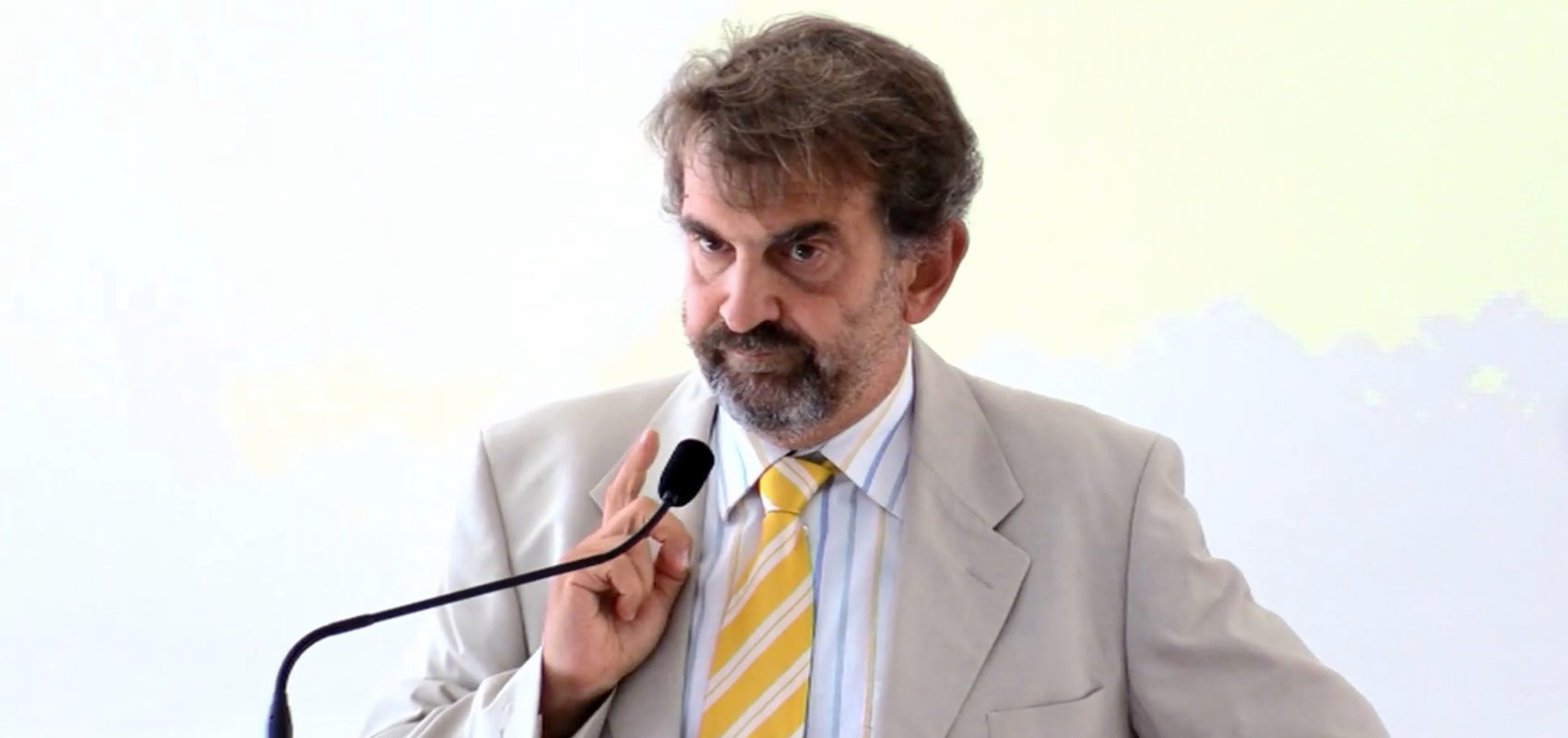
No one with any knowledge of Roman universities would be the least surprised to hear that Sant’Anselmo, a pontifical university with a reputation for liturgical studies, harbors a professor with liberal views such as Andrea Grillo. No one familiar with liberal Catholic theologians would be the least surprised to hear two further facts. First, that such a professor might supply theological justifications for the pet projects of senior prelates. Second, that these prelates would nevertheless not want to be publicly associated with the professor’s views.
Nearly twenty years ago, thanks to my involvement with Una Voce International, I found myself in a surreal correspondence with an episcopal conference about their objections to Pope Benedict XVI’s Traditional Mass version of the Good Friday Prayer for the Jews. The officials I was in touch with sent me a text by an anonymous theological advisor, but our exchange came to a halt after this person informed me that the “Consensus of the Fathers,” traditionally regarded as a source of infallible teaching, should be ignored because the Fathers of the Church were anti-Semites.
Such a claim would never be made by any of the bishops who had publicly objected to Pope Benedict’s prayer, but then they didn’t need to make it. They had a reasoned objection to the prayer from an “expert,” and that was enough to give them confidence to run with their instinctive dislike of it. The fact that their advisor relied on principles at right angles to the whole tradition of Catholic theology was not a public fact, and need not disturb them.
Pope Francis made frequent use of this approach. To speed up the annulment of marriages in 2015 he got an old canonist friend to draw up a motu proprio, Mitis Iudex. This relied on the principle (among others) that factors in a marriage that might be flags for further investigation, such as the couple being young or the bride being pregnant, were ipso facto signs of invalidity, so cases with these features could go on a fast track to annulment. Canonists pointed out the fallacy: Youthful couples and pregnant women are not actually impeded from contracting valid marriages. These objections made no difference: The motu proprio was a legal document, and the canons governing the procedure to be followed in annulment cases were duly changed; the cogency of the theological justification of the change simply disappeared in the rear-view mirror. There was very little defense of the document. The dogs barked and the caravan moved on.
Pope Francis followed the same procedure with the more puzzling aspects of Amoris Laetitia in 2016, and on the blessing of same-sex couples (Fiducia Supplicans, 2023). He wanted to change pastoral practice, and needed a theological justification for doing so. He found theologians who apparently supplied this, and stray phrases and other hints of their arguments found their way into the official documents. The more detailed version of the argument, whether reconstructed by critics or given by the theologian himself, was not part of the official text, however, so Pope Francis and his defenders could qualify or repudiate it as they wished. If the document was left without a real justification, it remained an official document of the Church, promulgated to the whole world, and it recommended a change in pastoral practice. The job, apparently, was done.
When Pope Francis wanted a justification for restricting what he called the Vetus Ordo, the Traditional Latin Mass, the theological explanation given in his 2021 motu proprio Traditionis Custodes seemed to be that liturgical pluralism was itself a threat to the unity of the Church, and, furthermore, the Church’s “law of belief” had to be based on the “law of prayer” set by the reformed, post-Vatican II liturgy.
It was quickly pointed out that these ideas, and even the verbal formulae used to express them, echoed the published work of Andrea Grillo of Sant’Anselmo. The theological implications of Grillo’s arguments, however, were giddying. Did the Church’s doctrinal fundamentals shift when Pope Paul VI published the new Missal? How do the liturgical traditions of Eastern Catholics fit in? What happens with new Western liturgies, like the use of the Ordinariate or the Congolese Rite? What are we to do with the millennium and more of theological work, including swathes of the Papal Magisterium, that was inspired or justified by reference to now-obsolete liturgical forms? Isn’t there a blatant contradiction between Grillo’s position and that of Pope Benedict XVI in his own 2007 motu proprio Summorum Pontificum: “What earlier generations held as sacred, remains sacred and great for us too”?
Of course, the fact that the document employed bits of Grillo’s argumentation didn’t imbue the professor’s positions with authority, or force Pope Francis’s supporters to defend them. The motu proprio was a legal document, they pointed out, which made legal changes. It behooves the Holy See to furnish such documents with some theological scene-setting, but the validity of the legal changes does not depend on the cogency of the theology. Catholic readers of the document are bound by the law, and they can like the theological justification for it or they can lump it.
Prof. Grillo, however, has continued to attract negative attention. He has criticized the newly canonized Carlo Acutis for an “infantile” eucharistic piety, and demanded the ordination of women for good measure. Mike Lewis, the most vocal defender of Pope Francis on X, called Grillo a “jerk,” and Sant’Anselmo distanced itself from his views with a public statement.
Grillo’s embarrassing opinions underline the wider problem. The use of theological arguments as non-load-bearing decoration for arbitrary legal impositions is not a sustainable way for the Church to operate. The emptiness of the theological justification for restrictions on the Traditional Mass reminds us that real pastoral harm can be done when the rules diverge from the Church’s own principles. The Church’s laws, practices, and liturgy should reflect her faith. Pope Leo needs to re-establish the correspondence of theory with practice.

YOU MIGHT ALSO LIKE
Turned Away on Palm Sunday
In politics, diplomacy, war, or pretty much any field of human interaction, one must contend not only…
Via Crucis, 2026
The Way of the Cross—and the third, seventh, and ninth stations in particular—has been an especially appropriate…
A Medieval Pilgrimage in Modern Assisi
When you go to the hilltop town of Assisi, you’re immediately struck by how medieval it is:…
