
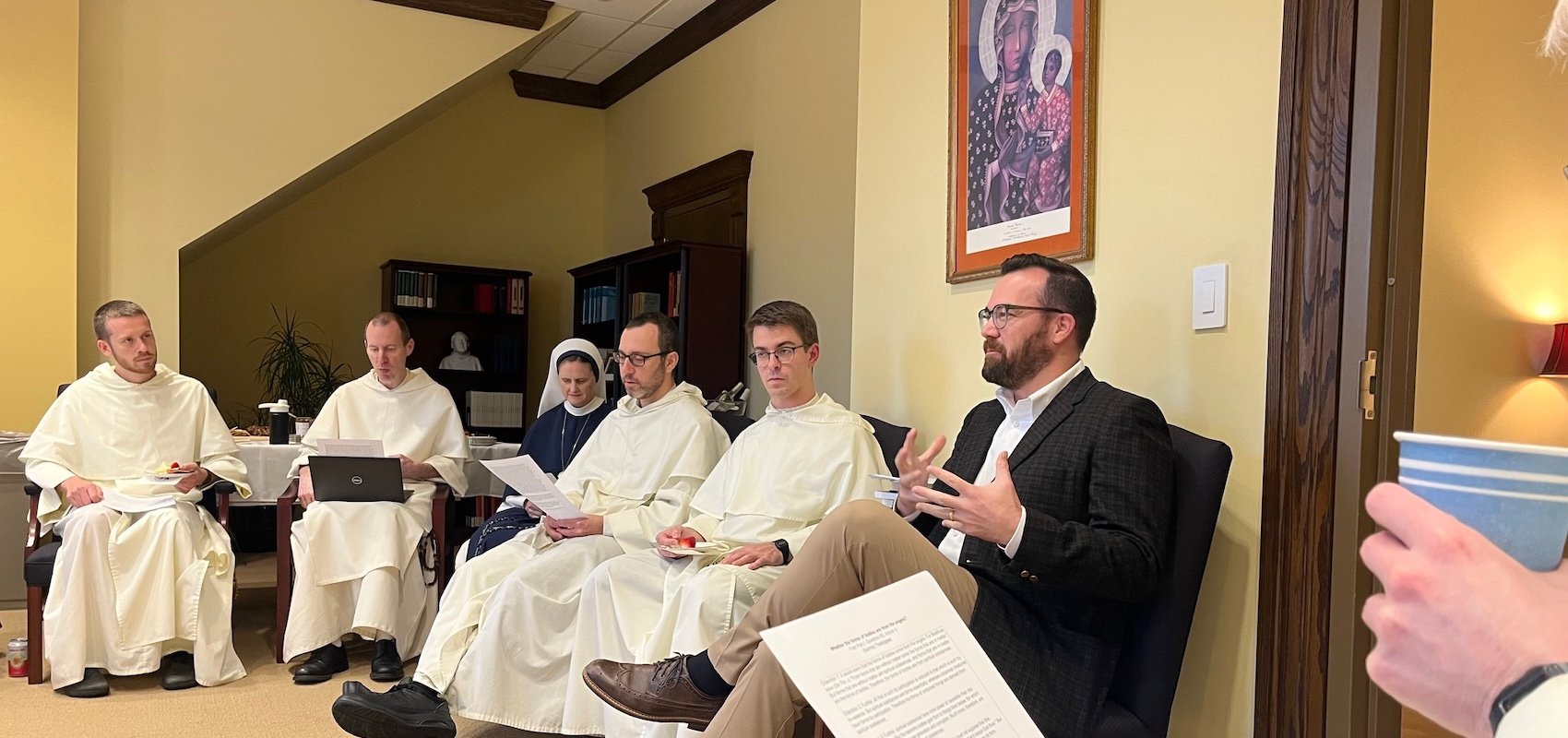
At 9 p.m., when most of the world is preparing for bed, a sea of white habits pours into the priory of the Dominican House of Studies in Washington, D.C. A stream of laity follows. Together on their knees, they chant the Divine Office:“O God, come to my assistance; O Lord, make haste to help me.”
My first time there, I was surprised to see that so many of the laity were college students. Instead of partying or studying late, they walk over from Catholic University of America’s campus to the priory for Compline. While the lay people will go home and return to their usual routines, the Dominicans will be back for Lauds at 7 a.m. to begin the day, a day where the bell will toll four more times for the Liturgy of the Hours. In between, brothers rush off to classes on the second floor, consecrating their minds to everything from Latin to metaphysics, as each one will have read Aquinas’s entire Summa Theologiae before they are ordained to the priesthood.
How do I know all this? President Dominic Legge appointed me as the McDonald Agape visiting scholar, a position reserved for Protestants. What has caught me off guard is the way the Dominicans expect me to be a participant rather than a mere observer. I am lecturing in class (on Protestant theologians, no less), joining Thomistic conferences with some of today’s most erudite intellectuals, leading soirees over topics of my choice, and participating in their spiritual retreats for university students. I am used to Protestants saying “ready, aim, fire” if there’s a Catholic in sight, but here I encounter Dominicans not the least bit defensive, confident that if they have truth, it will show itself.
I expected to see Dominicans devoting themselves to Lectio Divina—reading, meditating, praying, and contemplating the Scriptures. I did not expect to see Dominicans traveling the world at a neck-breaking pace for the Thomistic Institute, engaging universities with the truths of Thomism. My son caught on quick. “Why is there a dog in the statue of St. Dominic outside?” he asked. “Well, we are called the barking dogs because we bark the gospel everywhere we go,” said Fr. Dominic Langevin. Ready to engage the intellectual life wherever they find it, they see the whole world as their stage.
The experience has given me hope. In the past, ecumenism often meant debating distinctives that date back to at least the sixteenth century. This exercise has not generally been fruitful. Imagine two men arm-wrestling in a pub, each staring at his opponent. Suddenly, a storm erupts, and its wind brings the four walls crashing down. They are so caught up in themselves they don’t even realize the house has collapsed around them.
What should happen instead? The arm-wrestlers must lock arms, only this time to rebuild the walls. Their strength is far more effective together. The storm of secularism has hit Christianity, bringing down its walls. On this side of modernity, it’s time to link arms and rebuild, although neither side must compromise its distinctives to do so.
In the past, Catholics and Protestants have tried to unite around their theological distinctives, which usually results in them being watered down. What we need is a common architect around which we can unite, one who is especially equipped with the metaphysical tools that can help us rebuild the walls of Christianity: Thomas Aquinas. Sadly, while Dominicans have been applying the metaphysics of Thomism to the culture for centuries, most Protestants today are not. If the walls that have fallen are First Principles, then Protestants desperately need the metaphysical tools of Thomism.
In a world of skepticism, Thomism believes theology is a science, an organized body of knowledge dependent on the principle of non-contradiction. In an age of materialism, Thomism believes not only in matter, but form and therefore can give every person hope that their body is informed by their soul (hylemorphism). In a culture rampant with nominalism, Thomism says that universals are real, explaining all the otherwise meaningless particulars of our everyday experience. In an era swept up in naturalism, Thomism believes in causality, capable as it is to move from our sense experience to a First Cause by which all things live and move and have their being (Acts 17:28), thereby infusing our lives with purpose, or telos. In a day of expressive individualism, Thomism puts forward a real distinction between our essence and existence, one that reminds us we are dependent on a Creator who is simple. And, perhaps most importantly, in a world in constant motion, subject as it is to potency and act, Thomism asserts that our security resides in one who is pure act. As the unactualized actualizer, he can direct the fluctuating course of history to its fulfillment.
If real ecumenism is to have a future, it must oscillate around the perennial metaphysics of Aquinas. First, Protestants must learn from the Dominican rule of life. After my experience with them is over, I will be applying its basic principles by starting Anselm House, a school of philosophy and theology through Trinity Anglican Seminary where its fellows consecrate themselves to contemplation for the formation of virtue, as well as participation in the liturgy at St. Aidan’s Anglican Church. What’s distinctive about Anselm House? It is classical, retrieving the ecumenical creeds. It is Thomistic, committed to Aquinas’s First Principles and his way of doing philosophy and theology. And it is Anglican, allegiant to the reformed catholicity of the Thirty-Nine Articles and Book of Common Prayer. If Stewart Clem is right that the twentieth century “was the golden age of Anglican Thomism,” then the story of Anglican Thomism in the twenty-first century has yet to be written. In a small way, Anselm House will turn the page to that next chapter.
Second, talking across battle lines is not enough; real partnerships must begin. I am linking arms with Tory Baucum, director of the Center for Family Life at Benedictine College, and Msgr. Stuart Swetland, president of Donnelly College. Together we will launch Aquinas KC, a school for Thomistic catechesis, whose genesis began when Archbishop Naumann tasked Tory Baucum to find a creative way to do Thomistic catechesis. When Tory met me, a Thomistic Protestant, that original idea took on flesh. Our first project is a conference at Donnelly in Kansas City, where Catholic and Protestant scholars will gather around Aquinas as their “common doctor” to answer objections to Christianity in the culture. Then, we will launch Thomistic Fellowship Circles modeled after Jacques Maritain. Christians from various traditions will embark on a five-year tour, beginning with Aquinas’s biblical commentaries, then his homilies and hymns, and eventually his philosophy and theology, all for the sake of sharing Thomistic wisdom with the world.
Many Protestants will keep arm-wrestling, even if the walls have collapsed. It’s time to start building.

YOU MIGHT ALSO LIKE
Turned Away on Palm Sunday
In politics, diplomacy, war, or pretty much any field of human interaction, one must contend not only…
Via Crucis, 2026
The Way of the Cross—and the third, seventh, and ninth stations in particular—has been an especially appropriate…
A Medieval Pilgrimage in Modern Assisi
When you go to the hilltop town of Assisi, you’re immediately struck by how medieval it is:…
