
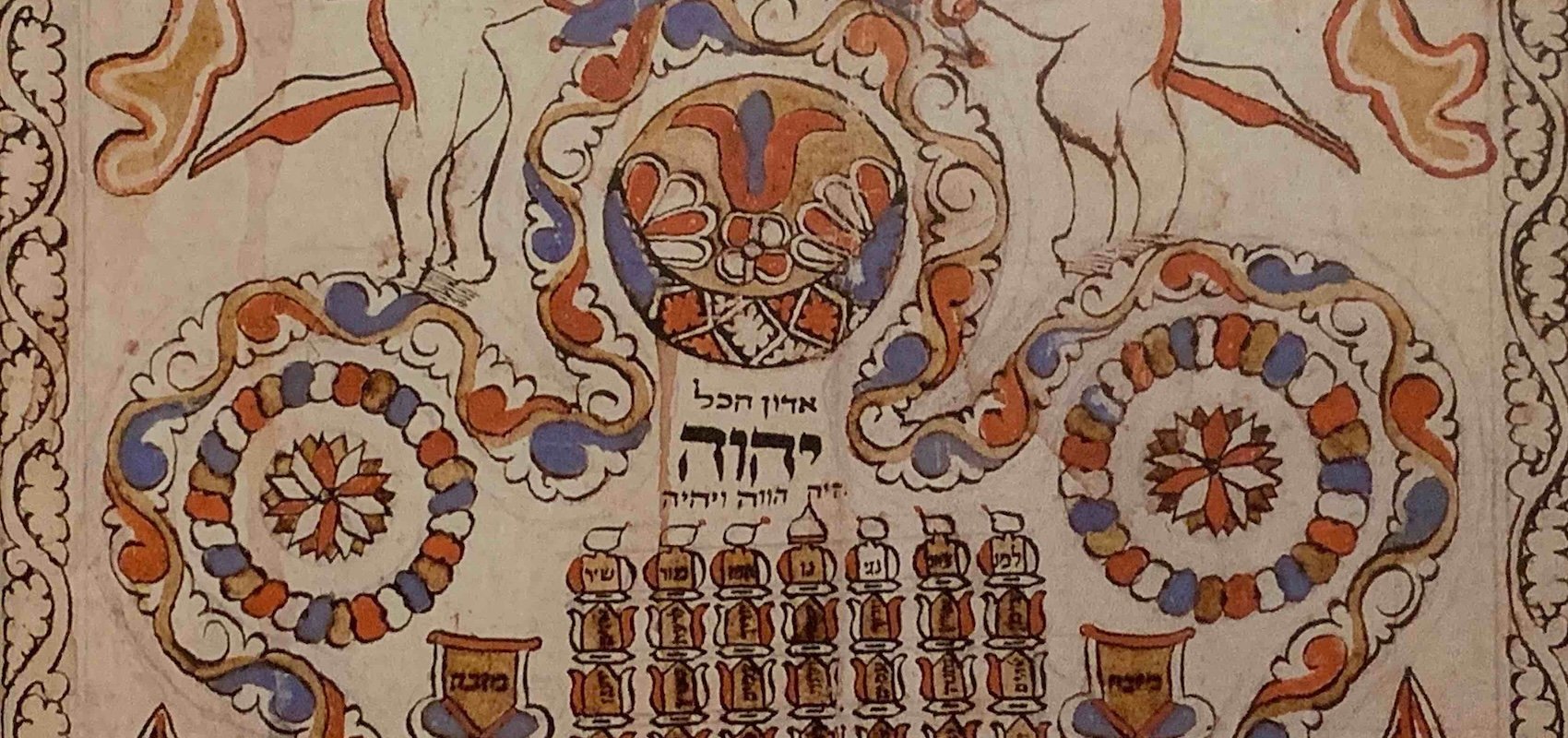
What is the proper spiritual posture from which to ask questions of a machine? Might formulating clever LLM prompts condition how we ask questions about, and put questions to, God? Are Jews—rigorously trained in iterative and dialectical reflections—uniquely prepared to adapt to the rise of AI? Can reading the Talmud teach us to be better programmers of the human soul? Or will the advent of AGI end human creativity? Is anticipation for the imminence of AGI similar to our longing for the Messiah?
A few weeks ago, a hundred or so young Jewish professionals, Yale alumni, and tech futurists gathered in the palatial Tribeca loft of former Worldcoin CEO and tech thinker Max Novendstern to seek answers to these and similarly improbable questions. The event, “AI and Jewish Mysticism,” was organized by Rachel Bitutsky, an alumna of Shabtai, the Yale-affiliated Jewish leadership society, and Shabtai’s Rabbi Shmully Hecht. The atmosphere was gracious and collegial, and the dialogue refreshingly outlandish.
Novendstern moderated a conversation between Stephen Kosslyn, the eminent Harvard University psychologist, and the Orthodox futurist rabbi Asher Crispe. The Jewish tradition of parsing religious texts, the panelists held, is similar to the architecture of learning machines trained to consume and synthesize seemingly infinite libraries of text. With a wry smile, Novendstern informed us early in the evening that he believes “actually existing AGI has a lot to do with the Jews!”
Kosslyn spoke in the manner of a skilled educator, proffering insights into the neurological and psychiatric implications of AI. He compared its usage to the grafting of a prosthetic onto the body. The structures of human perception, he argued, were already built into the architecture of AI; thus AI should eventually be able to do everything that human beings can. He concluded with a pragmatic argument that the Torah constitutes a body of self-sufficient knowledge.
Rabbi Crispe, on the other hand, led us straight into the mystical dimension. He synthesized a medley of references to classic Jewish texts with modern philosophy, duly invoking Lacan, Nietzsche, Derrida, and Saul Kripke’s modal logic. The rabbi playfully compared Kabbalah to the matter replicator in Star Trek (both create solid meaning out of thin air), and posited that Jewishness represented a refinement of adaptive algorithms. He riffed on the etymology of Hebrew concepts in order to “hybridize meanings to the next levels of polysemy.” It was like listening to a bizarro version of a Derrida who had attended rabbinical school only to become a tech theorist. At one point, a friend turned to me and praised the rabbi’s performance: He was either a genius futurist or a loquacious con artist in the tradition of Paul de Man.
Much of the debate focused on the advent of AGI, its implications for human society, and concerns about human-AI hybridization. “If you could give your child a pill that gave them a 2,000 IQ,” Novendstern asked, “would they still be considered human, worthy of the moral concern we afford to normal children? Either way, would you give your child the pill?”
Kosslyn was skeptical of mankind’s capacity to contain the robots after we had given them sentience. “The AIs will not necessarily want to be our slaves indefinitely,” he mused. He proposed “the idea of humans being found throughout the loop, where we become one energy—a synergy between the AI and us that goes back and forth.” He was likely alluding to Douglas Hofstadter’s thesis that human consciousness is a “strange loop,” in which the “I” of subjective conscious experience shapes the physical substrate of neurons from which it emerges. Accordingly, the ideal accommodation with AI would involve humans and AI each constituting the other in a feedback loop of mutuality.
Rabbi Crispe and Prof. Kosslyn disagreed on the core metaphysical question of whether AI could transcend its synthetic origins. They agreed, however, on the necessity of programming the AI to practice “epistemic humility.” Naturally, that impulse militates against the intentions of singularity-obsessed leaders of major AI companies. Here was a deeply Talmudic problem: Can epistemic humility be practiced by an artificial superintelligence created to be effectively omniscient? And if so, how might that humility be conferred to the individual human user, who may privilege ease and comfort even when it guarantees his obsolescence? Kosslyn’s view was that “many human professions will be replaced by AI. Yet AI will never be able to replace humanity.”
Rabbi Crispe questioned what it might mean for AI to exhibit signs of epistemic humility. He related this to Nietzsche’s critique of the “Immaculate perception.” Nietzsche employed the term to ridicule Enlightenment thinkers who chased pure, disinterested objectivity—the “view from nowhere.” Knowledge is inherently personal and, for humans, embodied, inextricable from desire. For machines to simulate human knowing, with its concomitant humility, they would need to make a metaphysical leap, acquiring bodily knowledge. It is impossible to imagine a machine “knowing” anything in the way that Adam had “known” Eve.
Despite their voluminous learning, neither Kosslyn nor Rabbi Crispe identified the Kabbalistic elephant in the room: the irreducibility of consciousness to physical causes. This is not the place to reproduce complex arguments from contemporary philosophy of mind, or to ponder “What is it like to be a robot bat?” Suffice it to say that it is no longer tenable for honest, informed thinkers to affirm purely materialist explanations for mind and consciousness. Ironically, given the evening’s concern with Jewish mysticism, a deeper appreciation for Kabbalah would have precluded such errors. The Kabbalistic worldview understands all reality, even inanimate matter, as emanating from, and unfolding within, the light of divine consciousness (Ein Sof). As such, even the silicon atoms of an AI’s processors are filled with divine light. This, it turns out, is the only way AI could bear even a semblance of consciousness—as one of the furthest emanations of Ein Sof, matter ennobled by and subordinate to human creativity. Unfortunately, the panelists didn’t tread here, even as they avoided numerous New Age-y pitfalls.
As my friend and I left the event, we met a Chilean professor of psychiatry from Yale who researches the effects of psychedelics on schizophrenia. He was impressed with the panelists’ insights into how to extract better responses to theoretical questions by iterating prompts with ever-greater precision. The evening had left him with a burning question: “Could AI teach us the secret name of God?”
With all due epistemic humility, I’ll venture a fittingly Kabbalistic answer: Yes, because we already possess it within ourselves.

YOU MIGHT ALSO LIKE
Turned Away on Palm Sunday
In politics, diplomacy, war, or pretty much any field of human interaction, one must contend not only…
The Scandal of Judaism
Christianity has been marked by hostility toward Jews. I won’t rehearse the history. I’ll simply propose a…
Introducing The Jew From Nowhere
Longtime readers of First Things will probably be able to guess the third in this sequence: Catholic,…
