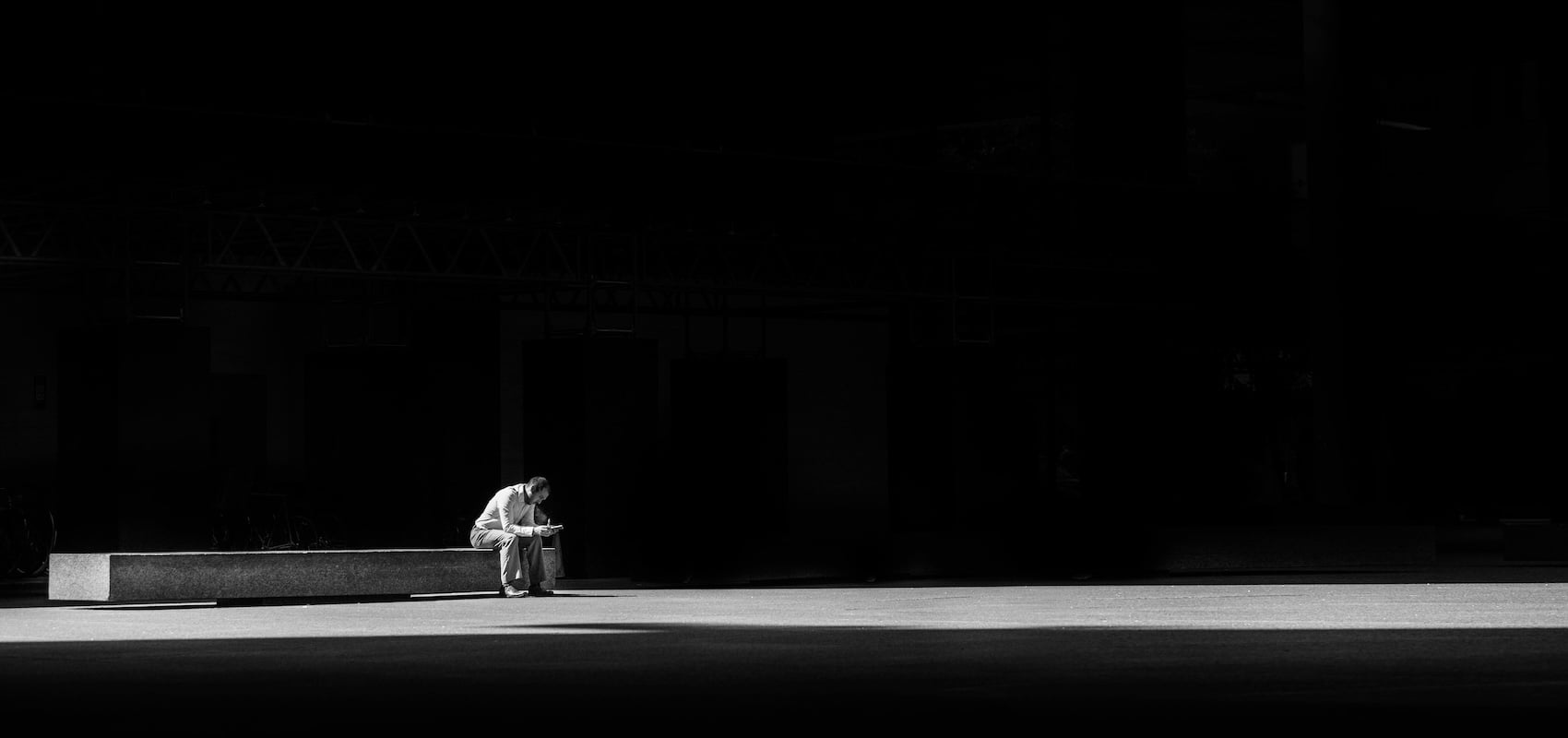
A few years ago, I had some routine surgery. Something went wrong in recovery. The nurses on the floor couldn’t fix it. They couldn’t find the specialist. It was Sunday. The pain steadily increased and, after three hours, became unbearable. A successful intervention was finally made after five hours, but not before I nearly blacked out in agony. “Blackness” is the word. For several hours, I thrashed in a tremendous struggle and stream of moaning appeals, amid an emptiness that seemed to contain only God and me. Just the two of us in the darkness. I had never felt such horror.
Perhaps being alone with God is not a good, but a sorrow. Alone, we are deprived of what we are most alike, creation itself. Reduced to solitude, we cannot rightly enjoy the one who has in fact made us, like Adam, the last of his creatures, did, surrounded by an earth and heaven filled with divine gifts of life. Being alone with God is, of course, something we shall all experience at some point. We call it “death.” With death, we leave behind the world into which we were born. “Darkness” precedes the creation of all things (Gen. 1:2); without this subsequent creation, including the creation of light, even “night” is no more or not yet (1:4–5), but something far different and far “deeper” (1:2) in its formlessness. For Augustine, the division of “day” and “night” is what allows our own darkened knowledge to be contained, ordered, and (at least potentially) led to the truth. Without the world, even God comes to us only as a deep gloom (Ps. 18:9–11; 97:2).
I still hear many sermons where “the world” is set up in opposition to God, and where our proper vocation is described as aiming at “God alone”—union with God alone, praising God alone, valuing God alone, serving God alone. But Deo solo, “by” God alone—grace—is not the same thing as Deus solus, only God. God’s grace is that by which we are never alone but are given into a world and given the world. The point here is crudely metaphysical: “Simply” to be a creature is to be in the world. Take away the latter, and there is nothing left of the former but a horrific tumble into the bottomless shafts.
Despite the hortatory encouragement to seek “God alone,” it is in fact theoretically impossible to imagine “just me and God,” for at least two reasons. First, Jesus asks us: “Have ye not read in the book of Moses, how in the bush God spake unto him, saying, I am the God of Abraham, and the God of Isaac, and the God of Jacob?” Jesus then asserts a conclusion: “He is not the God of the dead, but the God of the living” (Mark 12:26–27). At the least, this means that God is God of Israel, of Ur, of families and meals, of deserts, floods, tents, migrations, battles, burials, prayers, and songs sung along the way. Where shall we find God but among such things?
Second, it is theoretically impossible to imagine “just me and God,” because Jesus took our flesh—Adam’s flesh—into heaven, a flesh that is thus bound up with Abraham, Isaac, and Jacob and all that this implies. Even in heaven, therefore, we cannot be alone with God, but must be surrounded by families, generations, and lands somehow. Heaven, after all, is a place with “many mansions” (John 14:2), monai in the original Greek, a term closer to a “settlement” than to a desert hermitage.
The “world” is a necessary condition for our creation. Granted, the Bible has a range of terms that we translate with the English word, and some of them carry a range of meanings: erets, tebel,and olam in Hebrew, kosmos, aion, ge, and oikumene in Greek (or then the Latin mundus, saeculum). None of them functions neatly as a synonym for “creation.” Jesus has some starkly negative things to say about the world (kosmos): We cannot love the world and God at the same time (1 John 2:15–17), for it is in the power of the evil one (1 John 5:19). Nonetheless, “God so loved the world” (John 3:16) that Jesus “saves” it (John 12:47), and not just a part of it, but the “whole” (1 John 2:2). There are many of these paradoxical contrasts in the New Testament, giving rise to many arguments.
The English term “world” has expanded its semantic reach to include almost everything that touches the realm of our experience. And why not? The world is the place of our life, as Eden was in its already aged form when Adam was made. The world is the enveloping theater where object, color, sound, texture, and all the “forms” that populate our conjunctions and encounters are given to us such that we can live with God the Giver amid them. Just as in Eden, the world in this large sense also becomes a place of forgetfulness, distraction, rebellion, and malice (filled with “serpents”). But this does not alter the fundamental fact that the world bears our created lives in their intrinsic being.
I am puzzled at how often we reduce this grand realm of creation to a set of moral instruments handed to us to prove our value to “God alone,” whether by personal virtue, prayer, or political integrity. We insist that we must act well with “the other” in order to live well with God. Fair enough. But how puny such a perspective is, where this “other” becomes the tool for my own self, for “me and God”! No wonder supposedly (and proudly) “socially aware” people can discover, as the epitome of their other-oriented gaze, assisted suicide as a form of enlightened justice. “Me and God,” taken to the end of everything.
The truth is otherwise. The world is the condition of our lives, and hence we prize this world, with all its breadth and with all its crevices, peaks, pains, and losses, and seek its flourishing not so much out of self-interest, but because this is who we are. Augustine’s distinction between “use” and “enjoyment” is, in this context, potentially misleading. “Enjoy” only God, not the world, he argued; “use” (but do not enjoy) the world for the sake of God. Enjoyment of all that is around us can, to be sure, be a distraction from God. But it need not be—and should not be. Rather, unless we stand in the world with a sense of its giftedness by God, we cannot know God well. There is, of course, a God without the world. But there is not a me without the world, whether it is this one or the world to come.
That Jesus saves me from death means that he saves the world in which I live. This is not a claim about who gets to heaven or what a heavenly world looks like. The world, after all, is as complicated and liable to God’s unexpected reorderings as any artifact a mathematician could conjecture, and far beyond. Rather, it is a claim about our sense of self and its interests: Don’t run away from anything given you, let alone from everything. We find ourselves with God only among the “everythings” he has given us. I am suggesting not a program but an attitude, a hope, a bit of self-knowledge, for young people especially: Enjoy your parents and family, your neighbors, friends, and colleagues, even as they seem to stand as obstacles to your happiness. What is God’s forgiveness for—the forgiveness of the world!—unless it is to renew our joy in that very world of which we are essentially a part? I say this in the face of a culture that would reduce us to bare selves thrown into the downward swirl of disappearance.
One thing that happened in the hospital bed in which I faced the reality of being diminished to a lonely and darkened self was the arrival, late in my descent, of a hand that took mine into it. My wife Annette had arrived. With that, the world crept back in. And God was no longer “God alone,” the grim partner to my nothingness.
The end of the Book of Revelation is telling here. There is a “new heaven and new earth” (Rev. 21:1), which looks back to Genesis 1:1. While things certainly look different than in the world we now know, much remains that we do know: cities, walls, gates, streets, stones, gold, water, trees, fruit, and, of course, people. Lots of them, including whole nations and their rulers, pour into the center of this new earth and its city, carrying with them all that is best of their lives and their work. There is no darkness in the world to come; but neither is there the division of day and night. Now, only the light of God’s glory and of the Lamb. This is indeed a world, a perfect world, in which the “dwelling of God is with men” (Rev. 21:3)—a world in which I find myself not alone but wonderfully surrounded.