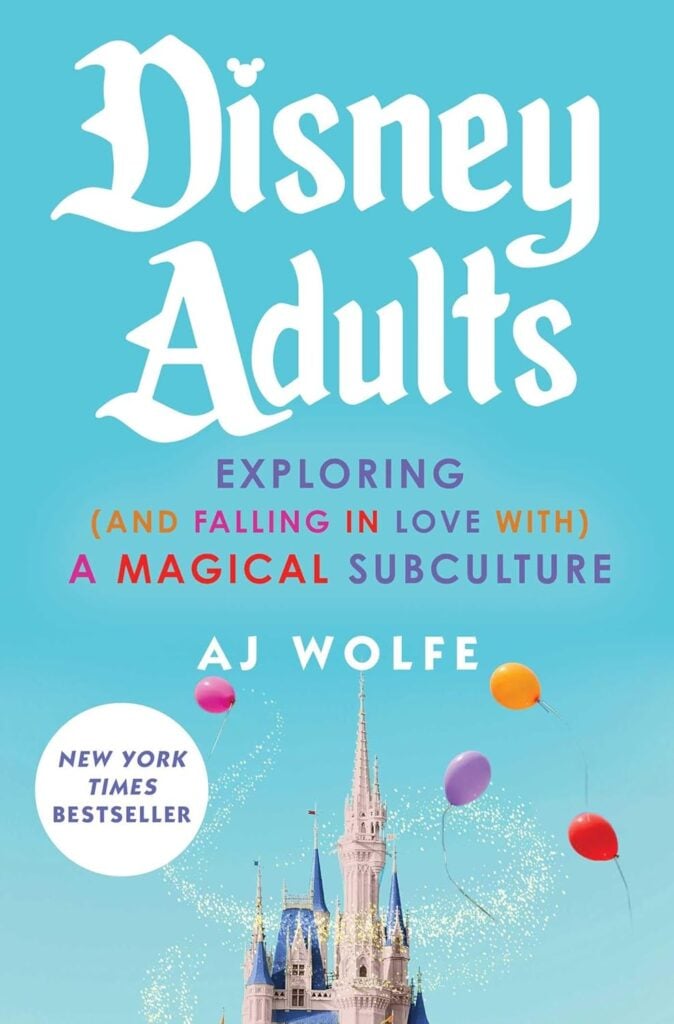
Disney Adults:
Exploring (And Falling In Love With) A Magical Subculture
by aj wolfe
gallery books, 272 pages, $28.99
I remember wondering, one idle summer when I was a child, why God had made the world so boring. I was watching a lot of kids’ TV shows about magical worlds, which made the real one seem as dull and gray and worn as my grandmother’s couch. I began to feel a real sense of despair that I couldn’t escape into these worlds. For years, I believed that my day-to-day existence was something to be grudgingly endured, made bearable by the fleeting comforts of make-believe.
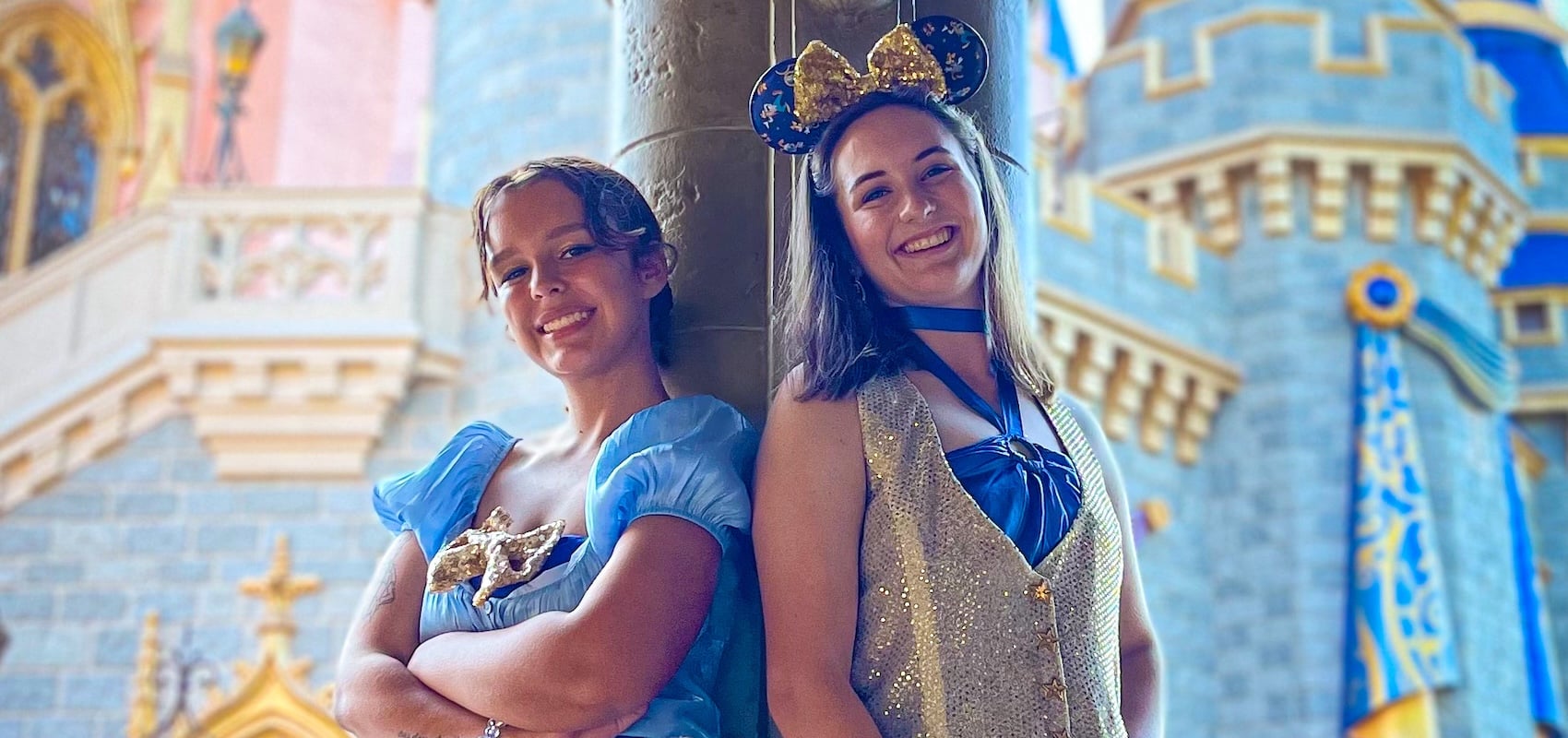
In March 2022, TikToker Jordan Jacee posted a short reaction video that provoked countless parodies and think pieces in mainstream publications. In the clip, Jordan sobs as the camera pans to—Disney World’s Cinderella Castle. “[Cue] the ugly crying. First time seeing Cinderella’s Castle in Magic Kingdom,” the caption read in the now-deleted post. A few months later, another TikTok video taken at Disney World went viral, captioned: “when you see Goofy coming around the corner after you’ve waited 3 years to hug him again.” The poster, Sarah Rachul, tearfully runs up to embrace the character. Rachul and Jacee are both adults.
Videos like these proliferate online. The criticism was swift: “I’m so scared of Disney adults,” read one comment on Jordan’s video. “It’s f***ing stupid mate, infantilism nonsense. Grow up,” read another in response to Rachul’s. But many were quick to defend “the most hated group on the internet,” as oneRolling Stone article dubbed the Disney fanatics. Among those defenses is AJ Wolfe’s bestselling book Disney Adults: Exploring (And Falling In Love With) A Magical Subculture. Wolfe argues that the Disney Adults phenomenon, which she participates in, should not be vilified. Rather, Disney Adults “are a telling microcosm of modern America,” offering a “glimpse [of] what it really means to be an adult in the twenty-first century.” If this is true, it is cause for concern. In 2009 Wolfe launched the Disney Food Blog, which has millions of subscribers and followers on its social media pages. “I spend an inordinate amount of money, time, and brain cycles on this hobby,” she writes, “and I’m not alone. There are millions of us. And for many, it’s a hidden obsession.”
Disney Adults are “avid fans of the animated or live-action films, devotees of the Disney theme parks, collectors of the vast world of Disney merchandise, [and] cosplayers who dress in clothing inspired by Disney characters.” According to Wolfe, they are “often maligned in mainstream culture and put on a particularly high pedestal of cringe. But in truth, their obsessive fandom hints at a universal desire for pleasure and joy, for magic and escape.” Escape is the key word throughout most of the book. Wolfe describes how, in her late twenties, she “relied heavily on the ‘magic’ of Disney” to get through the drudgery of work, her best friend’s cancer diagnosis, and a quarter-life crisis. She would spend “hours each week fantasizing and obsessing over Disney World,” creating trip itineraries on her Staten Island Ferry commutes and going “into $17,000 of credit card debt while booking trips to The Most Magical Place on Earth,” where she could “let go of all the stresses of real life and hide in a cocoon of happiness and fantasy.”
Wolfe’s experience is mirrored in the accounts of the Disney Adults she interviews for her book, and though she admits that the obsession can go “too far”—one chapter is titled “When You Love Something Too Much”—the crux of her argument is as follows: For many, Disney is the spoonful of sugar that helps the medicine—as in, “real life”—go down. The trick is to figure out how to “keep a foot in both camps—i.e., obsessive fandom and functional reality.”
No doubt this is a fair account of why Disney Adults need their fix. We all need little joys and escapes in life. But it doesn’t address the real reason for the mockery. Much of the criticism leveled at Disney Adults seems to grasp that grown individuals ought to have matured in their definition and experiences of joy and happiness. When it comes to the theme parks, it’s all about brain chemistry, as Wolfe notes. Disney “makes a point of making everything they offer as good . . . [and] as craveable as possible for all of your senses,” from “the smell of the water inside the Pirates of the Caribbean ride” to “the sound of the music piped into the lobby at Animal Kingdom Lodge” to “the bright colors and fantasy architecture at Pop Century Resort. Pangs for these can be as palpable as hunger for a Disney Adult.”
Different areas of Disney World have custom scents sprayed into the air “to solidify sense of place,” exploiting the ability of smells to trigger emotions and memories. “All these tricks make the most of your brain’s tendency to passively engage with your environment.” Disney wants “to create strong, saturated, positive sense memories that your brain will crave again and again.” In other words, Disney wants its consumers to become Disney addicts—what some call “Mouse-aholics.” It should come as no surprise that a place where embodied experiences are prioritized is so popular in an increasingly digital and virtual world. Corporations have happily filled the gap left by the bygone village square or the internet-free café down the block. But in doing so, they have infantilized us.
Wolfe is well aware of the mechanisms that have inspired her devotion. Disney initiates “new devotees,” she says, through “serotonin, dopamine, endorphins, and love. Just kidding. Serotonin, dopamine, endorphins, and money.” Many Disney Adults are fully aware that Disney is a corporation “built around monetizing emotions like joy and fulfillment,” and that while they may love all things Disney and derive strong purpose and meaning from it, the company is—as one former employee puts it—“never going to love you back.”
A fundamental aspect of Disney World is its predictability and consistency. Why go to Disney World, or take a Disney cruise, instead of flying to, say, Italy or Japan? It’s “easier.” “I knew, based on brand alone, that whatever I did,” Wolfe writes, “was probably going to be pretty high quality.” At Disney World, you’re treated like “royalty.” It’s clean and safe; everyone “[speaks] English and use[s] American dollars.” The most you have to do is open your wallet and swipe your credit card. As Wolfe puts it: “When I sat on a bench or waited in a queue for my favorite ride, I didn’t have to work to find happiness in the same way that I had to work to find it in my real life.” Disney World is like a liminal space where time doesn’t exist and you can surrender all real-world responsibilities. It is a place where you can live an “effortless existence.”
One pleasure Disney trades on is nostalgia—for childhood, for “simpler times.” Pandemics, wars, broken families, and a global economy that is leaving most millennials worse off than their parents drive this generation to seek solace in the childish comforts of Disney. As Wolfe notes, “nostalgia” is etymologically rooted in the Greek nostos, meaning “homecoming.” Going to Disney World can feel like coming home.
The decline in religious affiliation contributes to our homesickness. Wolfe observes: “There’s been some chatter in recent years about people treating Disney like a religion, or a sacred space.” People make “pilgrimages” to the parks and “scatter ashes of their loved ones in the Haunted Mansion,” as if it were hallowed ground. They “buy funeral urns etched with images of Disney World’s Cinderella Castle.” When you’re at Disney World, you feel kinship with fellow park-goers over your shared love of the brand, like a congregation gathering at a house of worship.
It is also a very popular wedding destination; among those who have been married there are Florida governor Ron DeSantis and his wife. But, as many will recall, the DeSantis–Disney love story soured in 2022 when Disney criticized Florida’s Parental Rights in Education Act, dubbed the “Don’t Say Gay” law. The resulting feud, and the split among fans, was revelatory: For many, Disney—more than a hundred years old, and nigh inseparable from America as we know it today—serves as their moral compass. “We know that this company—possibly more than any other—will shape the values, mores, politics, ethics, and personalities of generations to come,” Wolfe observes. No wonder, then, there is so much furor over its messaging—from the inclusion of a lesbian couple in Lightyear (2022), to the removal of DEI language from its 2024 business report.
On the one hand, Disney itself does not want to carry the burden of being a quasi-religion. “[Our mission] should not be agenda-driven. It should be entertainment-driven,” then-CEO Bob Iger declared in 2023. On the other hand, Disney does everything in its power to “own” its audience from the moment they’re born to the moment they die—to be a key source of fulfillment and meaning in their lives. “Of the self-proclaimed Disney Adults we surveyed, 72.4 percent reported that they first engaged with Disney before age six,” Wolfe notes. The company is also venturing into the gaming industry, which will allow them to get a “leg up on Gen Alpha and potentially even Gen Beta.” Disney made the unprecedented decision to lean “hard into a sports betting empire,” which generates billions in revenue, after Iger noticed his adult sons’ use of sports-betting apps. And finally, the company is “currently building retirement communities to ensure they can maintain their consumer even longer. Of the 1,315 Disney Adults we surveyed, 91.3 percent said they believed they would be Disney Adults until they died.” When Neil Postman wrote Amusing Ourselves to Death, his critique of the entertainment society, he may not have imagined the titular phrase being lived out so literally.
The birth dearth will no doubt force Disney to pivot even more toward its adult consumer base. And adults, without adult responsibilities such as raising kids, will continue “claim[ing] childlike pursuits.” In her own study, Wolfe found that “nearly a quarter, on average, of the Disney park guests waiting in line to meet characters were adults without children.”
One of Wolfe’s interviewees, a grandma, senses that there may be more to life. She “started to question just how much time, money, and energy she was spending on trips to Disney World rather than serving her faith community” and began to tell herself that she needed to put down her “idol of Disney.”
Wolfe’s diagnosis of twenty-first-century adults is correct, but it is telling that she feels no need to prescribe a cure for mass infantilization. I can all too easily sympathize with the Disney Adults, seeking wonder and joy in a return to childish fantasy. But for me, adulthood has brought the hard-won realization that the world we inhabit is full of wonders enough—wonders that make you realize, as Rilke did, “You must change your life.”
Image by Maryon Grace, licensed via Creative Commons. Image cropped.