
It never ceases to amaze me how clearly prominent intellectuals at the end of World War II foresaw today’s ideological struggles. One of my favorites is the Swiss philosopher Denis de Rougemont. In La Part du Diable (The Devil’s Share), first published in 1944, de Rougemont states: “Here lies the new tragedy: we have foreseen everything against a future Hitler, nothing against his absence, which is nevertheless certain. And this is the Devil’s opportunity for tomorrow.” He goes on to say: “The theological naiveté of our century is one of the most considerable advantages of the new barbarism.”
Recent decades have vindicated de Rougemont’s prediction. Consider Germany’s president, Frank-Walter Steinmeier. Though he says that the “perpetrators” are different today, he insists on Hitler’s continuous presence. On January 23, 2020, in a speech delivered at Yad Vashem, Jerusalem’s Holocaust memorial, Steinmeier warned that Germany still faces “the same evil” that existed during the Nazi era. The specter of Hitler was also the focus of his most recent speech, given on November 9—the most symbolic and fraught date in recent German history. According to Steinmeier, November 9 serves as “the core of our identity.”
In his speech, Steinmeier made clear that he considers the AfD (Alternative for Germany), the allegedly extremist and anti-democratic right-wing party, Hitler’s successor. It is as de Rougemont predicted. Unable to imagine that economic, social, and demographic crises—not Hitler—are driving voters toward the AfD, the political establishment feels justified in exercising a continuously lawless, anti-democratic campaign against the party.
Steinmeier is now openly calling for a ban on the AfD—in the name of “defensive democracy” (“wehrhafte Demokratie”), of course. “Let’s do what needs to be done,” he urges. The remarkable mixture of helplessness in the face of voter dissatisfaction and autocratic arrogance did not go unnoticed, even by mainstream media. The German political establishment faces an obvious dilemma. Eight state elections are coming up next year. Polling suggests growing support for the AfD. The establishment must either launch a risky attack on democracy and “elect a new people,” as the German author Bertolt Brecht once quipped, or be voted out of power.
Steinmeier is in a certain sense right when he accuses the AfD of being unconstitutional. The Federal Republic, almost from the beginning, has had two constitutions: the written one—the Grundgesetz, dating from 1949—and the “lived” one, the anti-fascist constitution. The second, unwritten constitution is animated by an ideology Paul Gottfried describes in his 2021 book Antifascism. The crisis of meaning in modernity, the disenchantment with socialism that had already taken hold during the Stalin era, and the collapse of the Eastern Bloc caused the German left to take a new form. It became “the political incarnation of unconditional morality,” as the Berlin philosopher Peter Furth put it in 1990, and unconditional morality turns on resisting “the same evil.”
The rise of this unconditional political morality began in the immediate postwar period. First came “Gruppe 47,” an influential literary group, and the return of the Frankfurt School (“Marxism without the working class”) in the early 1950s. The turbulent 1960s and the terror-marked 1970s are well known. Both decades saw the beginnings of a paradigm shift in public attitudes. However, until the end of the Helmut Kohl government in 1998, the written constitution clearly dominated in terms of state policy.
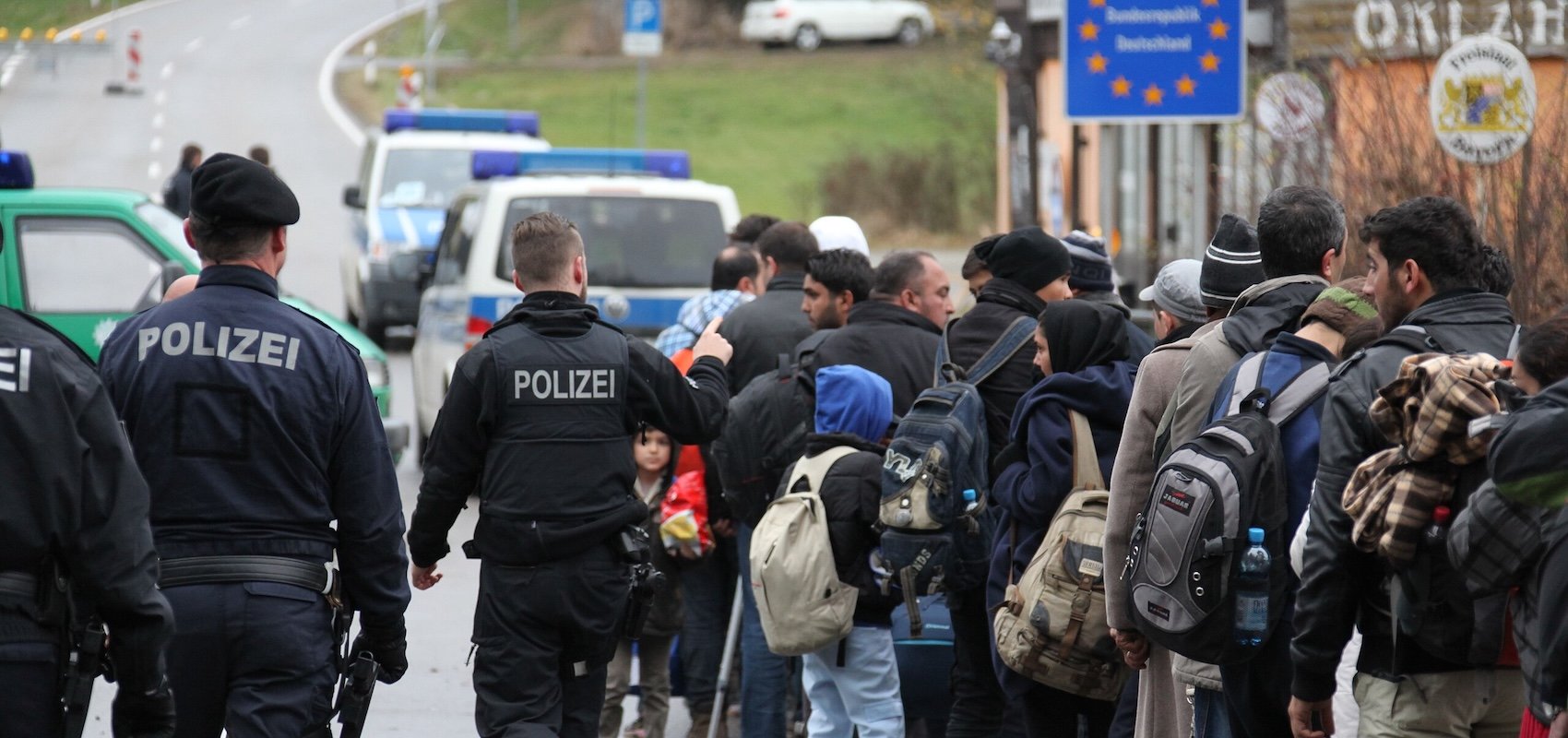
Since then, the lived constitution—significantly influenced by the German Democratic Republic’s old-fashioned communist anti-fascism after reunification—has been replacing the written one. On February 20, 2016, seventy-six personalities from Berlin’s cultural scene celebrated Chancellor Merkel’s opening of the border, signing a tribute advertised in Die Welt. It reads as if Merkel had personally defeated Hitler by welcoming a million Muslim migrants. The relief of these people was enormous: They were finally free from a Germany capable of “the same evil.” Hence the indifference with which German elites regarded Merkel’s breaches of law.
What Steinmeier calls “defensive democracy” obscures a creeping coup d’état. The AfD is an enemy of the lived constitution. The government is determined to revise (without saying so, and without voter consent) the written constitution so that it serves the unwritten one, even if that means openly violating the Grundgesetz. Of course, for German elites, the lived constitution has moral priority. Thus, the central issue in the conflict with the AfD is less about constitutional law and more about salvation history, one that follows the concept of the “optimistic tragedy.” Like the 1932 play of the same name by Vsevolod Vishnevsky, the secular salvation history promoted by Germany’s establishment promises a positive meaning, even for a tragic event. According to this concept, the global catharsis of defeating Hitler once again will be worth the German sacrifice. The idea makes me shudder, but only time will tell what the future has in store.
Image by Metropolico.org, licensed via Creative Commons. Image cropped.
