
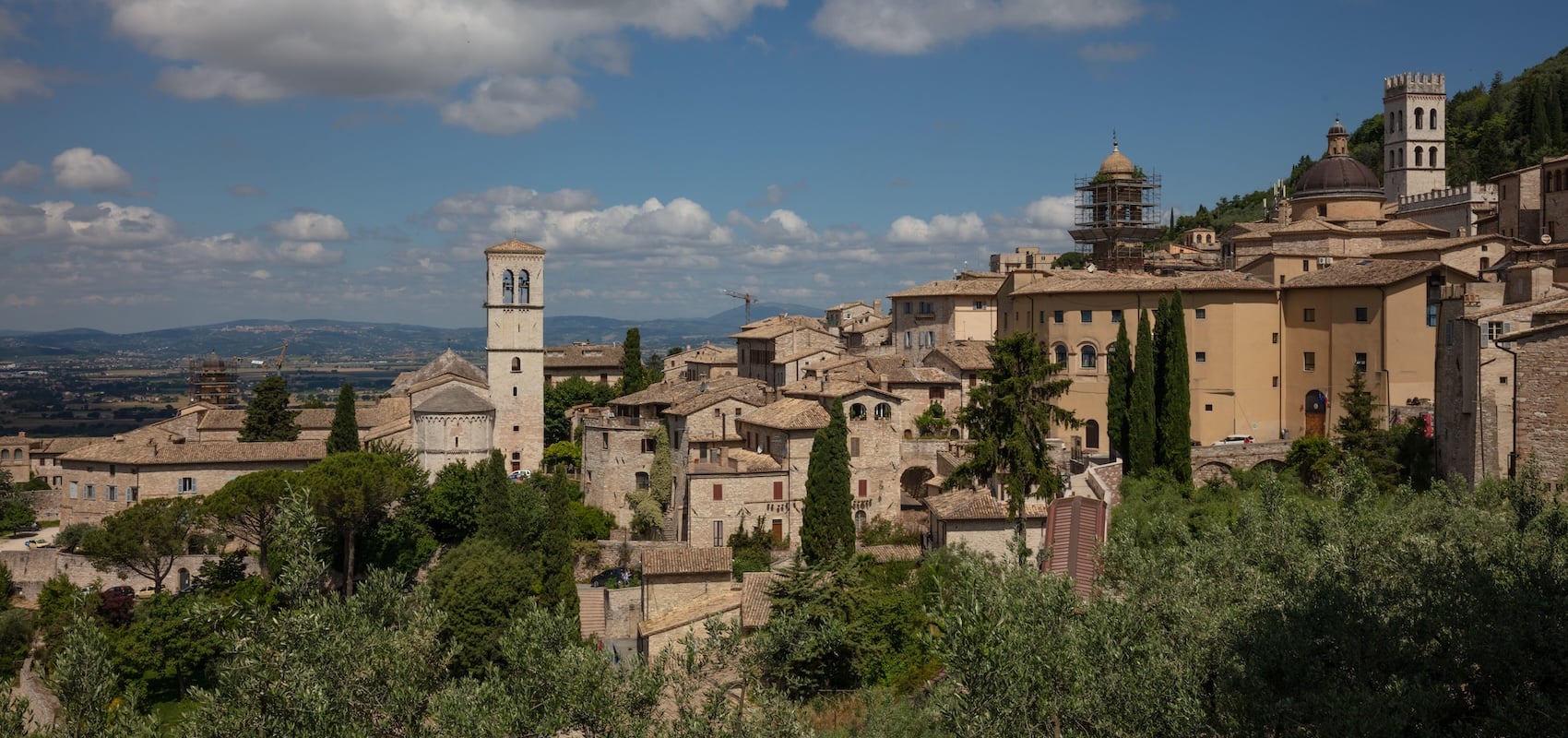
When you go to the hilltop town of Assisi, you’re immediately struck by how medieval it is: narrow alleys, steep streets, stone arches, ancient temples transformed into Christian churches, and everywhere unexpected views of the beautifully preserved Vale of Spoleto, the peaceful agricultural valley full of olives and grapes. But the next thing you notice is how much this town has been ensconced in what Walker Percy, in his essay “The Loss of the Creature,” called the “symbolic complex.” An elaborate system of interpreters and rules and tour guides and ticket offices and gift shops and time schedules and public transportation has grown up around the original object and encrusted the reality of what you came to see and experience.
Perhaps that shouldn’t come as a surprise. If a city of 28,000 inhabitants hosts four million visitors annually, then it’s inevitable that the original experience of medieval sanctity of Francis and Clare and the early Franciscan Order will be packaged within an elaborate system designed to preserve and present it. Impatient tourists need information and gifts and food, and they need it quick so that they can get back to Florence and see what’s in the Uffizi. To put it otherwise, Assisi is one part medieval sanctity, nine parts tourism.
Images of St. Francis in the innumerable little souvenir shops are repackaged to suit contemporary tastes: pastel images of him with a big toothy smile, giving Eskimo kisses to baby lambs. As a culture, what we value is not so much purity or contemplative depth but being nice. We dress up our saints much like we dress up our pets—in our own image. But anyone who has spent thirty minutes with Francis’s own writings or Bonaventure’s Life of St. Francis of Assisi has been struck by how stern, how ascetical, how, well, medieval Francis really was. Francis, writes Bonaventure, was “unbending in discipline. . . . Around the beginning of his conversion, in wintertime he often plunged into a ditch full of icy water in order to perfectly subjugate the enemy within.” “For many years he never tasted bread or wine” and was often “fatigued from . . . prolonged activity and feeling hungry.” Yet he would not “turn back from the promise [he] had made to holy poverty.” He trained himself to kiss the sores of lepers.
In contrast to our contemporary images of the saint, the images of Francis made within a century of his death offer a glimpse of that stern medieval Francis: the Francis of fasting, ecstasy, humility, and poverty; the Francis who modeled his life on that of St. Anthony of Egypt, St. Martin of Tours, and St. Benedict, and who would have felt at home with St. Patrick, St. Aidan, and St. Cuthbert. In short, this Francis was the founder of a worldwide movement that preached contrition and repentance, not the founder of the religion of the golden doodle.
For these reasons, I’ve always had complicated feelings about Assisi. When I went to Assisi for the first time at nineteen, the Franciscan Order was trying hard to find common ground, to be as inoffensive as possible, to find the lowest common denominator with anyone who had even the vaguest spiritual aspirations. And so, at least from its public presentation of itself, it had become something indistinguishable from the rainbow peace flags everywhere during that time, or John Lennon’s “Imagine.” At the same time, I was there at an ideal moment: It was a cold and wet February, and very quiet. The stone streets were almost deserted. We walked around, were told what paintings were made in what year, and were then given pasta. Nevertheless, it felt like something was sleeping in Assisi, deep under the symbolic complex. Perhaps this is the greatest testimony to Assisi’s holiness, that it has managed to preserve something of its deep and frankly mysterious and mystical past, despite the crushing crowds.
I returned to Assisi this Lent on a Friday. This year is special, of course, marking the 800th anniversary of Francis’s death. To celebrate the occasion, the bones of Francis were put on display in the basilica during the month of February. To see them, you had to make a reservation, go through security checkpoints with metal detectors, and pass through all of the gates of the symbolic complex. I thought I was in for another experience of tourism. But when we assembled and our Franciscan guide met us, I was shocked. He didn’t tell us how old the paintings were or how tall the tower was. He preached. He said that Francis was special because he loved Jesus to the point that he wanted not just to help the poor, but to be poor, as a way of participating in the God-man’s poverty. He told us that Francis asked to be stripped naked on his deathbed, so that he could die like Jesus in nudissima paupertas. He told us that it wasn’t too late for us to convert, and that there would be a dozen priests, waiting in a special chapel to hear confessions of any pilgrims who wanted to repent. Our group processed into the lower basilica behind him in silence, coming up to the glass case that held St. Francis’s bones. Some laid their hands on the case or set upon the glass their Franciscan Tau cross, the symbol of repentance. We looked at the very medieval frescoes of the lower crypt, in silence. And in the confessional, a patient Franciscan put his head down on his hands to listen hard to what you had to say.
Later, on the same Lenten Friday, we went down the hill to see the Portiuncula within the Santa Maria degli Angeli, the church within a church, where Francis prayed in the early days of the order. The Stations of the Cross, with at least three hundred people, were being conducted with elaborate Mediterranean piety: emotive, plaintive, very embodied, lots of kneeling and striking of breasts. The priests chanted the Stabat Mater in Latin, and the congregation responded in Italian. No one was looking at screens or booklets. They had it memorized. The experience brought with it all the exhilaration of a large group of pilgrims from across the world, praying, singing, kneeling, and repenting. In other words, I had stepped into a medieval pilgrimage.
Never have I felt what I thought had been buried deep down, underneath the symbolic complex, brought so remarkably to the surface. What had been sleeping was living and breathing again. At least in this war-torn and anxiety-ridden Lent, the way of Francis is on display in Assisi in all its mysterious and difficult beauty.
