
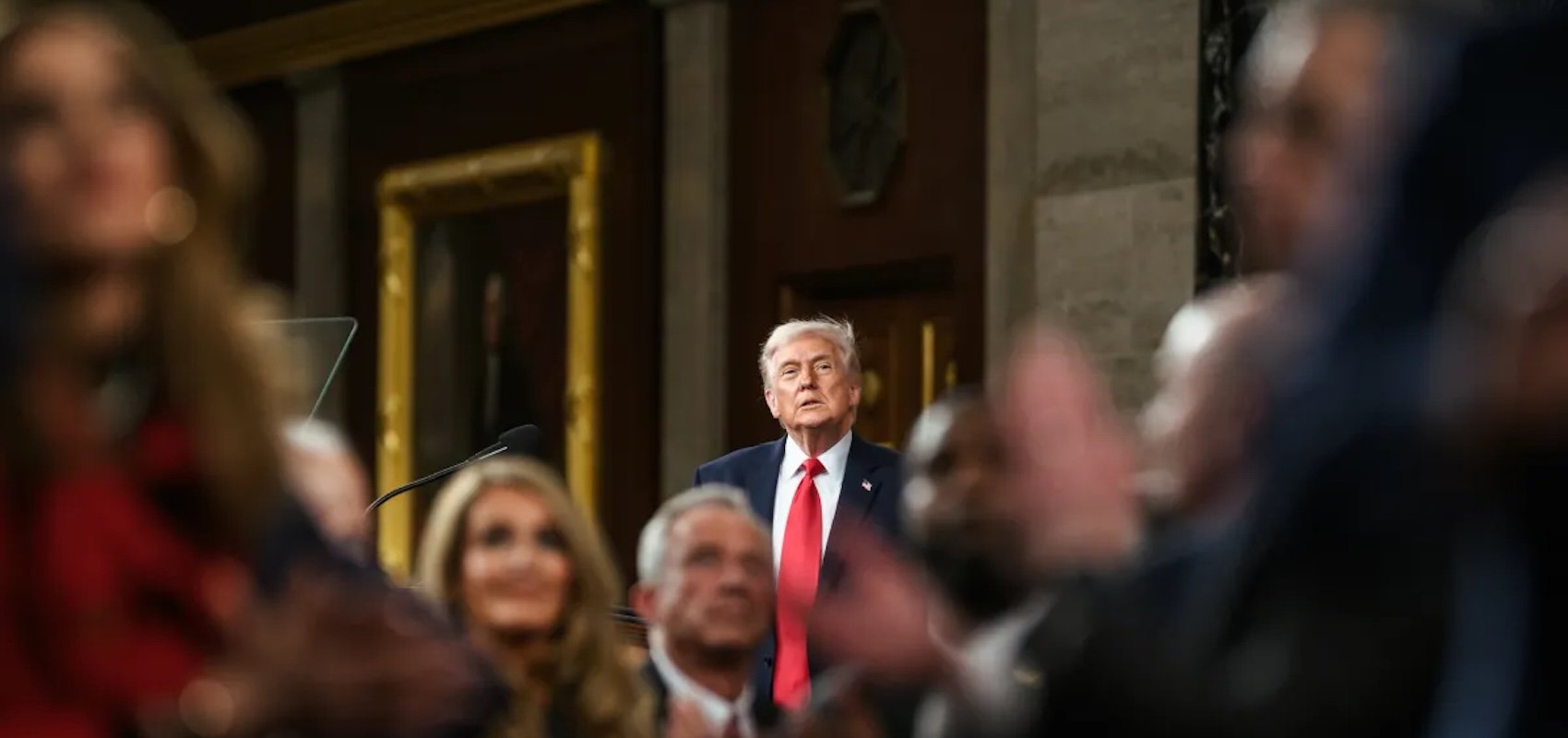
The State of the Union message to Congress is mandated in the Constitution. But it does not mandate what it has become: an annual spectacle that is a sort of civic theater for the benefit, not of Congress, but of the executive branch. It is an admixture now of free airtime, especially valuable in a campaign year; advocacy and announcements for the true locus of American governance; and incidentally, a report on the state of the Union. President Donald J. Trump did not create this state of affairs, but with his entrepreneurial showman’s instinct he has exploited the format to its fullest.
None of this is to say that there is no content to the State of the Union address. There is, in fact, quite a bit, but it must be understood in its full context. This week’s address contained the usual laundry list of policy ideas and initiatives, many quite good, all crafted toward a particular desired narrative, and all grounded within a particular understanding of American civics. That understanding is worth illuminating, because it provides the key to grasping what, exactly, the administration of Donald J. Trump is for, what it means, and what it will do.
One of the core themes of the Trump era is the restoration of what may be called dignitas. Trump evidently believes that ordinary Americans bear dignitas as much as he does. This is starkly visible in the 2026 address, which spends a great deal of time elaborating upon various measures and outcomes meant to increase the dignitas of the ordinary American. American drug prices will be lower. Healthcare will get price transparency. Peace will be pursued. Households will be protected from data-center-driven electricity rate spikes. Eggs are affordable. Gas is cheap. Investment firms won’t buy up housing stock. DEI programs are out. Workers and the elderly will get tax breaks, the young will get investment accounts, and everyone without access to employer retirements will get access to federal worker-type plans.
One datum, so astonishing that it earned a fact check from CBS News (which pronounced it entirely true), was that the U.S. murder rate across the past year experienced its greatest decline in 125 years—a figure so extraordinary that it would be cause for public adulation and celebration if only the president were of a different political party. Here we see another use of the modern State of the Union, in providing news that the great apparatus of the media will not.
All of this may be interpreted as a response to Franklin D. Roosevelt’s observation that needy men are not free men, with the key difference being that Trump favors not direct provision of needs, but policies that make it easier for Americans to provide for themselves.
The address also gave voice to what Churchill called the “things of the spirit.” The president notably reflected upon religion and faith, themes that have become increasingly prominent in his public remarks over the past two years. His remarks on faith are often accompanied by reflections on his own mortality and the urgency of his presidential mission. The honor accorded to Erika Kirk and the denunciation of political violence conveyed a similar measured gravity. As did two of the most moving moments of the evening, the award of two Medals of Honor to American heroes who fought, seven decades apart, in both Korea and Caracas. These should be thematically combined with the honor shown the U.S. Men’s Olympic Hockey team—not that sport is remotely comparable to combat, but both are products and causes of civic virtue. A free nation requires heroes of both battlefields and sports fields. Thanks to the decision of the U.S. Women’s Olympic hockey team to absent themselves, these virtues as set forth in the address are presented as explicitly masculine.
This is what the State of the Union showed us: The Trump administration is for Americans, not in the abstract, but in the particular. The president’s gamble in asking all to rise for the prioritization in governance of those Americans, with the Democrats refusing to do so, illustrated that point vividly. Over the past ninety days, the administration has quietly issued a corpus of works that are now the constitutive canon of its tenure. In this light, the address is an end rather than a beginning, given that it was preceded by the National Security Strategy, the National Defense Strategy, the Maritime Action Plan, the State Agency Strategic Plan, and the secretary of state’s Munich address. These documents among themselves set forth a coherent and emphatic view of civics and America that the address embodied, serving as the culminating statement, only this time with promises of easier days and with the examples of bloodied heroes.
This is the stuff of democratic republicanism. As such, this State of the Union serves not just as a report, but as instruction.

YOU MIGHT ALSO LIKE
Timothée Chalamet Is Right About Art (ft. Suzy Weiss)
In this episode, co-founder and reporter for the Free Press, Suzy Weiss, joins Virginia and Germán to…
Trump’s Civilizational Project
Secretary of State Marco Rubio spoke at the recent Munich Security Conference. Last year, Vice President JD…
The Real JD Vance (ft. Frank DeVito)
In the latest installment of the ongoing interview series with contributing editor Mark Bauerlein, Frank DeVito joins…
