



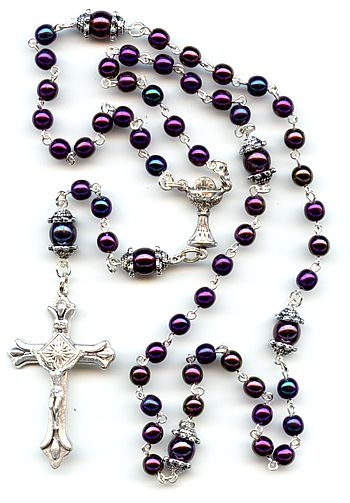
We are given to understand that many religions have something akin to prayer beads to assist the devout in saying their prayers. The rosary is one such aid used especially by Roman Catholics. However, it seems that the prayers accompanying the rosary long ago supplanted the Psalms for the use of illiterate people who had no access to the latter. Here is the story, according to this website:
The Rosary is actually believed to have developed as a result of the monasteries, because in the monasteries the monks would pray the Psalms, 150 altogether. However, many monks as well as townspeople were unable to read, but wanted to be in solidarity in prayer with the monks, and so developed a means of praying 150 “Our Fathers” which later, given the rise in devotion to Mary, added the “Hail Mary” as well. This is why sometimes the Rosary is called “Mary’s Psalter.” However, what would happen is given the amount [sic] of prayers, it would be hard to keep track, so they developed a sort of abacus in order to keep count, originally it was stones but later developed into beads on a string.
This is confirmed elsewhere. Finally, here is the account given in the Catholic Encyclopedia (with sources deleted for ease of reading):
But there were other prayers to be counted more nearly connected with the Rosary than Kyrie eleisons. At an early date among the monastic orders the practice had established itself not only of offering Masses, but of saying vocal prayers as a suffrage for their deceased brethren. For this purpose the private recitation of the 150 psalms, or of 50 psalms, the third part, was constantly enjoined. Already in A.D. 800 we learn from the compact between St. Gall and Reichenau that for each deceased brother all the priests should say one Mass and also fifty psalms. A charter in Kemble prescribes that each monk is to sing two fifties (twa fiftig) for the souls of certain benefactors, while each priest is to sing two Masses and each deacon to read two Passions. But as time went on, and the conversi, or lay brothers, most of them quite illiterate, became distinct from the choir monks, it was felt that they also should be required to substitute some simple form of prayer in place of the psalms to which their more educated brethren were bound by rule. Thus we read in the “Ancient Customs of Cluny”, collected by Udalrio in 1096, that when the death of any brother at a distance was announced, every priest was to offer Mass, and every non-priest was either to say fifty psalms or to repeat fifty times the Paternoster. Similarly among the Knights Templar, whose rule dates from about 1128, the knights who could not attend choir were required to say the Lord’s Prayer 57 times in all and on the death of any of the brethren they had to say the Pater Noster a hundred times a day for a week.
I am unaware of any Reformed Christians using a rosary, and certainly no Reformed church endorses the practice. However, I have come across two efforts to reconnect the rosary with its origins in the Psalms and other scriptures: Pray the Rosary with the Psalms and The Daily Prayer Rosary.


